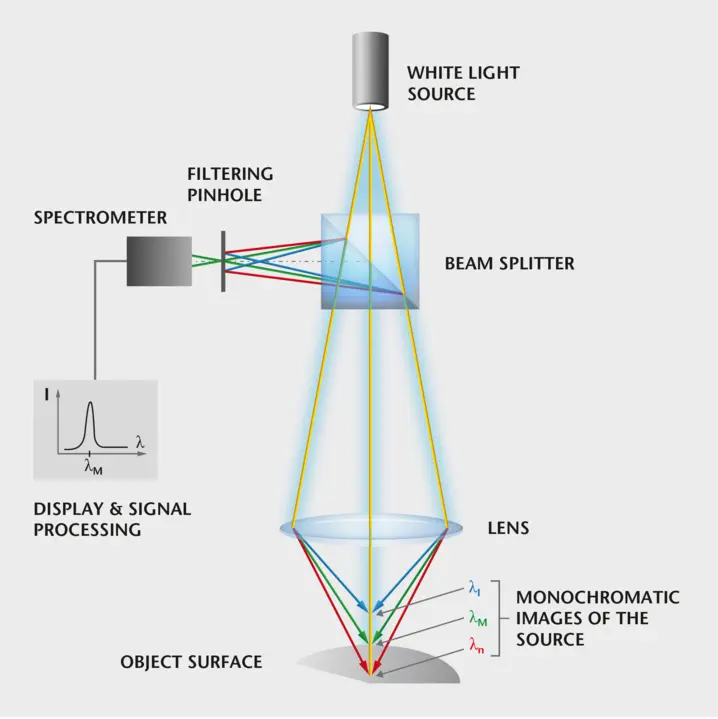
The chromatic-confocal measurement principle
Chromatic confocal method for optical measurement technology for measuring distance and thickness has been established as one of the mature methods available to industry and research in surface metrology. Incident white light is imaged through a chromatic lens to yield a continuum of monochromatic light along the z-axis, thereby “color coding” the optical axis. When an object is present in this color field, a single wavelength is fixed to its surface and then reflected back to the optical system. The backscattered beam passes through a filtering pinhole and is then acquired by a spectrometer. The beam’s specific wavelength is calculated to precisely determine the position of the surface in the measurement field. Chromatic confocal technology allows reliable, accurate and reproducible dimensional measurements with high resolution.
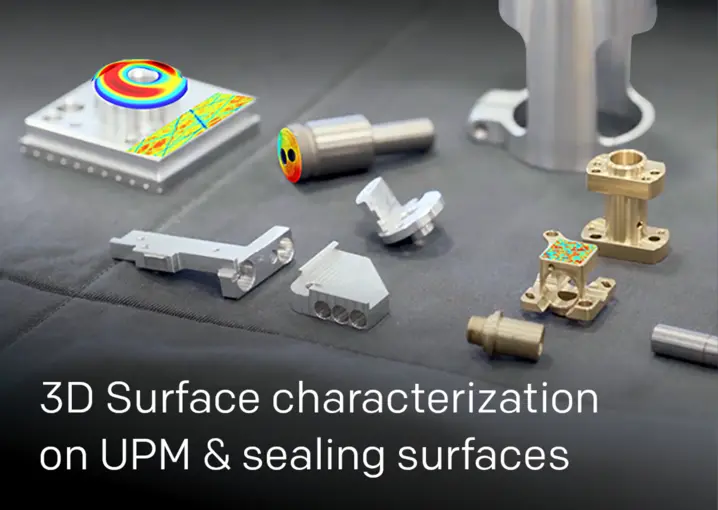
Free webinar "Characterizing ultra-precision & sealing surfaces"
Compact web talk on 3D surface characterization of ultra-precision machined (UPM) and sealing components — from lapped, CNC ground to polished texture and finish.
Find out more about the strengths and limitations of the different and common surface measurement methods in the technology comparison, regarding vertical and lateral resolution, application sweet spots on smooth surfaces or roughness measurement, with or w/o stitching.
- White-light interferometry
- Confocal microscopy
- Focus variation
- Chromatic confocal sensors
Take a look at our wide range of WLI profilers
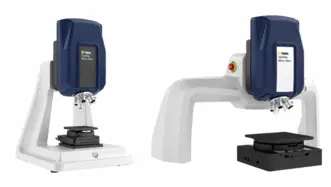
Micro-Profiler
Micro.View profiler systems are optimized for measurements with sub-nanometer resolution. With focused optics and high vertical resolution they enable detailed analysis of microstructures, surface finish and material distribution where even the smallest deviations matter.
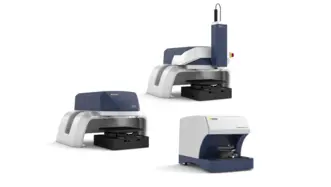
Macro Profiler
Pro.Surf inspects flatness, step height and parallelism on large parts and multi-part trays — non-contact, in seconds. No-crash telecentric optics measure even into bores, with the precision and repeatability production demands.
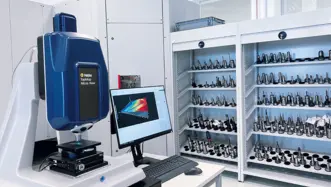
Roughness Deal Days
Save 30% on Polytec’s optical Roughness Tester—precise, non-contact 3D profilometry with sub-nm resolution. Offer valid until October 31, 2026.
Related stories and downloads

Interview with Prof. Dr. Albert Weckenmann about optical and tactile surface measurement technology
We talked with Prof. Dr. Albert Weckenmann of the University of Erlangen-Nuremberg, Germany, about the limitations of tactile surface measurement technology and the opportunities of non-contact methods.
Overview of optical methods for surface metrology
For applications where tactile surface measurement techniques have shortcomings, non-contact optical instruments have been developed to overcome these shortcomings. Especially with the development of compu…
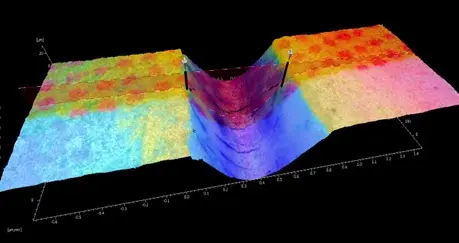
How CSI technology retrieves superior topography, form & roughness measurement data
Read how the optical technology of Coherence Scanning Interferometry (CSI) analyzes topography, form & roughness, where are sweet-spots, benefits and applications compared to related optical surface inspec…
Downloads
Discuss your demands with our experts
Let’s start with a short discussion about your parts, tolerances, and workflow—and, if useful, we can add a feasibility study, PolyMeasure (contract measurements), or a PolyRent trial as optional next steps.