1. Introduction to fiber optic sensor technology
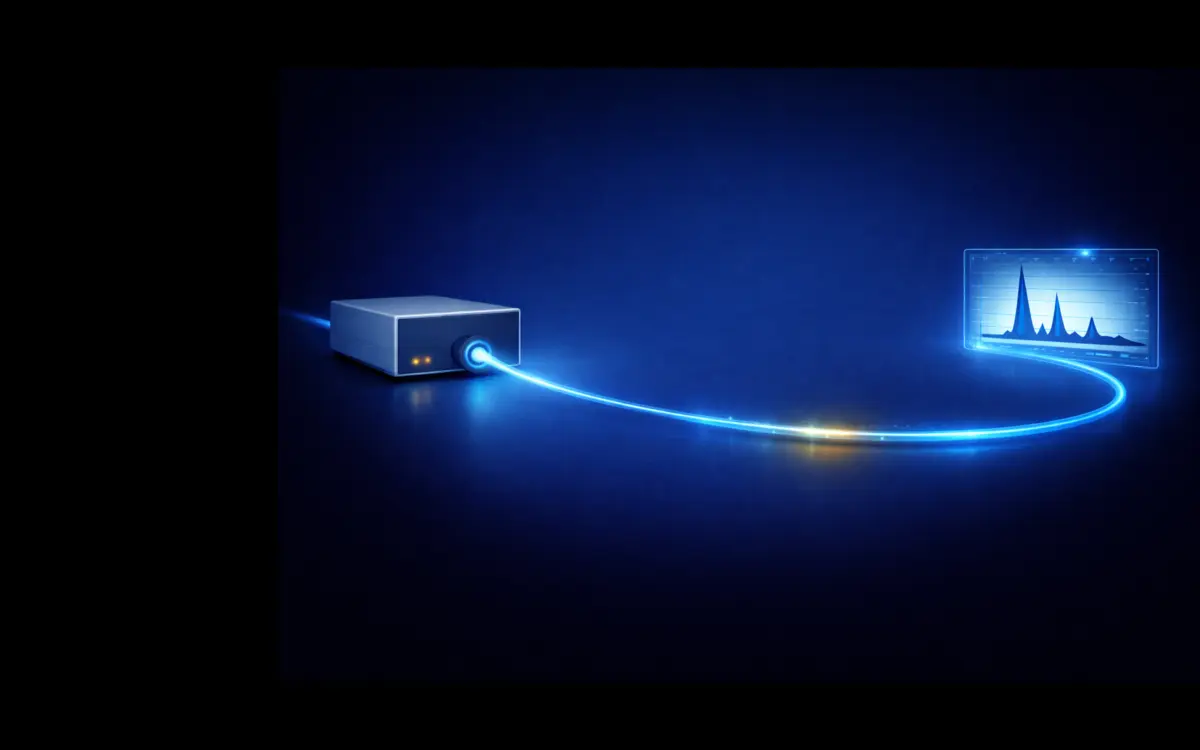
Fiber optic sensor technology uses light as an information carrier to measure physical variables. Optical signals are transmitted through a glass fiber. If external influences such as temperature, strain, pressure, or vibration change along the fiber or at its end, the measurable properties of the light change—for example, intensity, phase, wavelength, scattering or polarization behavior.
The key advantage is that the glass fiber itself becomes the sensor. It is electrically insulating, immune to electromagnetic interference, corrosion-resistant, and suitable for extreme environments. This makes fiber optic measurement systems particularly suitable for applications in high-voltage environments, potentially explosive areas, energy technology, industrial plants, or safety-critical infrastructures. Its small diameter also allows it to be flexibly integrated, e.g., into copper coils of electric motors or composite laminates of wind rotors.
Different physical effects are used depending on the measurement task. Some sensors measure at a defined point, others detect several discrete measuring points along a fiber, while so-called distributed methods enable a continuous profile over many kilometers. These are based on established optical principles such as interference, wavelength shift, or light scattering.
Fiber optic sensor technology thus combines the physical precision of photonics with the robustness of industrial measurement technology – and opens up solutions where classic electrical sensor technology reaches its limits.
2. Classification
Fiber optic sensors can be classified according to the type of measurement value acquisition along the fiber, among other things. This classification based on the measurement task is particularly practical.
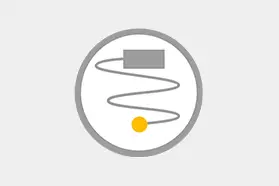
2.1 Single-point sensor technology
In single-point sensor technology, the actual sensor element is located at a defined point—usually at the end of the fiber or in an integrated sensor head. The fiber primarily serves as an optical signal transmitter.
Characteristics:
- A clearly defined measuring point
- Very high accuracy and dynamics possible
- Particularly suitable for selective temperature, pressure, or strain measurements
- Compact sensor geometries compared to electrical measurement techniques
Typical applications include high-voltage environments, transformer monitoring, medical technology, and industrial process measurement.
2.2 Multi-point sensor technology
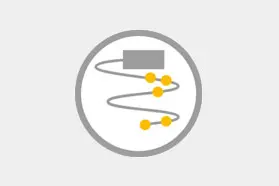
Multipoint systems enable multiple discrete measuring points along a single fiber. These can be defined in almost any spatial arrangement and can be distinguished by wavelength or signal coding, for example.
Characteristics:
- Multiple defined measuring points on a single fiber (typically 15–30, under certain conditions up to 1000 per fiber is possible)
- Reduced cabling effort
- Good scalability
- Frequently used for structural monitoring or larger machines
This technology combines the precision of point sensors with the efficiency of a shared fiber infrastructure.
2.3 Quasi-continuous or distributed sensing
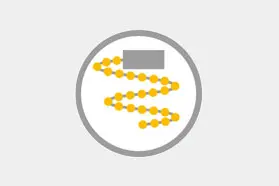
In distributed methods, no sensors are embedded in the fiber; instead, the fiber properties themselves are utilized. Each section of the fiber acts as a sensor element. The location information is derived from the transit time or frequency analysis of the backscattered light.
Characteristics:
- Continuous measurement profile of several kilometers possible
- Spatial resolution ranging from millimeters to meters, depending on the measurement method
- Ideal for linear infrastructures such as cable routes, pipelines, or tunnels
These methods enable comprehensive condition monitoring, in which temperature, strain, or vibration profiles are recorded over long distances
These three categories form the structural framework for the different physical measurement principles, which are explained in more detail in the next section.
3. Measuring principles of fiber optic sensor technology
3.1 Single-point sensor technologies
3.1.1. Semiconductor absorption sensors (semiconductor bandgap, e.g. GaAs)
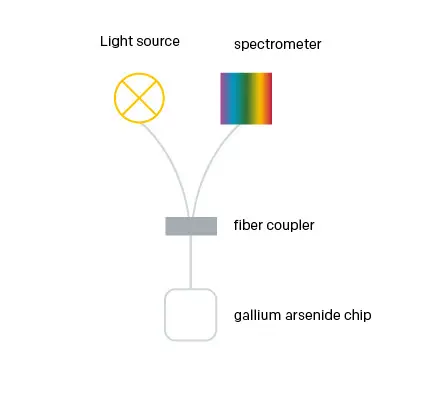
In this method, a small gallium arsenide crystal (GaAs) is located at the tip of the fiber. The temperature-dependent shift of the optical absorption edge of the semiconductor changes the reflected or transmitted light spectrum. The temperature is determined from this spectral change.
Typical measured variable: Temperature
Strengths: EMC immunity, high long-term stability, suitable for high-voltage environments
Typical applications: Transformer monitoring, high-voltage systems, industrial processes
3.1.2 Interferometric sensors (e.g., Fabry-Pérot)
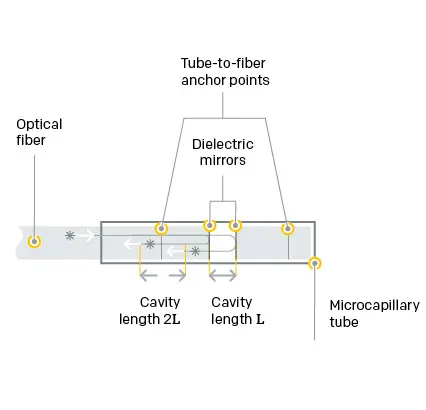
Interferometric sensors are based on changes in optical path length. Two reflective surfaces form a cavity. If their distance changes due to pressure, strain, or temperature, the interference pattern of the reflected light shifts. This phase or intensity change is evaluated with high precision.
Typical measured variables: Pressure, strain, temperature, acoustic signals
Strengths: Very high resolution and dynamics
Typical applications: High-pressure measurement, medical technology, vibration analysis
3.1.3 Fluorescence or phosphor-based sensors
Here, a temperature-dependent luminescent material is optically excited at the sensor head. Changes in the intensity, spectrum, or lifetime of the fluorescence provide the measurement signal. The fiber serves only as a light guide.
Typical measured variable: Temperature
Strengths: Electrically insulated, robust against EMC
Typical applications: Industrial plants, medical applications
3.1.4 Polarimetric sensors
These sensors use changes in the polarization state of light in a magneto-optical material. An external magnetic field—for example, the field of a current-carrying conductor—causes the polarization of the light to rotate. This change in polarization can be used to determine the magnetic field strength and thus, indirectly, the electric current.
Typical measured variables: Current, magnetic field
Strengths: Non-contact, high-voltage resistant
Typical applications: Energy transmission, grid monitoring
3.2 Multi-point sensor technologies
3.2.1 Fiber Bragg gratings (FBG)
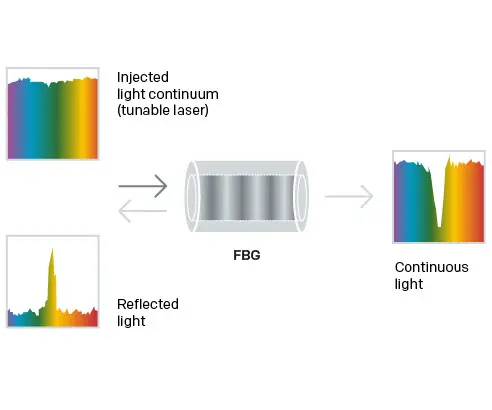
FBGs are periodic refractive index modulations within the fiber that reflect a specific wavelength. If the temperature or strain changes, this reflected wavelength shifts. Several FBGs with different Bragg wavelengths can be integrated along a fiber and read out together.
Typical measured variables: Temperature, strain, pressure (indirect)
Strengths: Many discrete measuring points on one fiber, good scalability
Typical applications: Structural monitoring, wind energy, mechanical engineering
Note: In industrial practice, 15–30 FBGs per fiber are common; specialized systems enable significantly higher grating numbers. Multiplex operation across multiple channels is also possible.
3.2.2 Multiplexed interferometric sensors
Multiple interferometric sensor heads can be operated on a single fiber using spectral or temporal multiplexing techniques. Evaluation is performed using interferometric demodulation, for example by means of white light interferometry.
Typical measured variables: Pressure, strain, acoustic signals
Strengths: Very high resolution at several defined measuring points
Typical applications: Special applications with a few high-precision measuring points
3.3 Quasi-continuous (distributed) sensor technology
3.3.1 Rayleigh-based methods
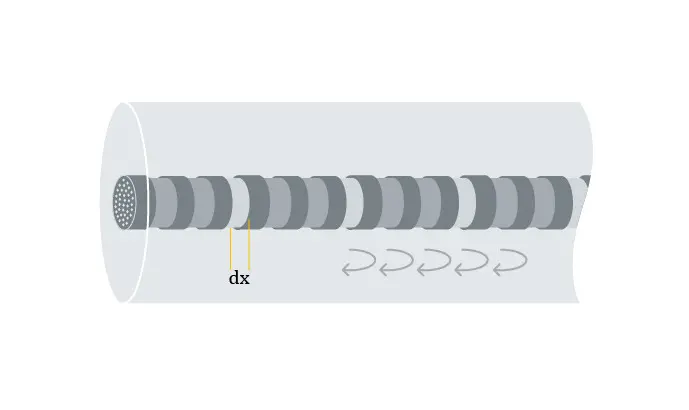
Rayleigh scattering is caused by microscopic inhomogeneities in the glass of the fiber. The characteristic backscatter signal of the fiber changes when local strain, temperature, or vibration changes. These changes can be analyzed with spatial resolution.
Different technologies are used depending on the evaluation method:
3.3.1.1 Rayleigh OTDR (e.g., Distributed Acoustic Sensing – DAS)
In OTDR-based systems, short laser pulses are fed into the fiber. The transit time of the backscattered signal provides location information along the fiber.
Typical measured variables: Vibration, acoustic signals, dynamic strain
Strengths: Event detection over many kilometers, complete strain or temperature profile along the sensor fiber
Typical applications: Pipeline monitoring, perimeter protection, infrastructure monitoring
3.3.1.2 Rayleigh OFDR (Distributed Strain/Temperature Sensing)
OFDR systems use a frequency-modulated laser and analyze the spectral Rayleigh scattering pattern of the fiber. This pattern is unique for each fiber location. Changes due to strain or temperature shift the local scattering spectrum and can be evaluated with high resolution.
Typical measured variables: Strain, temperature
Strengths: Very high spatial resolution (mm–cm range), high sensitivity, continuous measurement profile along the entire fiber
Typical applications: Building monitoring, structural testing, fiber composite structures, material testing
3.1.2 Raman-based Distributed Temperature Sensing (DTS)
Raman scattering is temperature-dependent. The ratio of stokes to anti-stokes components of the backscattered light enables spatially resolved determination of the temperature along the entire fiber.
Typical measured variable: Temperature
Strengths: Long ranges (several kilometers), robust temperature profiles
Typical applications: Cable monitoring, tunnels, energy technology
3.1.3 Brillouin-based Distributed Temperature and Strain Sensing (DTSS)
In Brillouin scattering, light in the fiber interacts with acoustic lattice vibrations in the glass, known as acoustic phonons. These microscopic sound waves in the material change the refractive index and cause a small frequency shift in the scattered light. Since this shift depends on temperature and strain, both variables can be measured along the fiber.
Typical measured variables: Temperature and strain
Strengths: Combination of two measured variables, long ranges
Typical applications: Structural monitoring, geotechnical engineering, energy infrastructure
4. Overview of fiber optic measurement methods
| Measurement method | Classification | Physical principle | Typical measured variables | Typical applications | Characteristic strength |
|---|---|---|---|---|---|
| Semiconductor absorption sensor | Single point | Temperature-dependent shift of the optical absorption edge of a semiconductor | Temperature | Transformer monitoring, high-voltage systems, industrial processes | High EMC immunity and stability in high-voltage environments |
| Interferometric sensors | Single point | Change in optical path length leads to shift in interference signal | Pressure, strain, temperature, vibration | Medical technology, high-pressure measurement, acoustic sensor technology | Very high resolution and dynamics |
| Fluorescence/phosphor-based sensors | Single point | Temperature-dependent change in intensity or lifetime of luminescent materials | Temperature | Industrial plants, medical applications | Good long-term stability and EMC immunity |
| Polarimetric sensors | Single point | Magnetic field causes rotation of light polarization in a magneto-optical material | Current, magnetic field | Energy transmission, grid monitoring | Non-contact current measurement at high voltage |
| Intensity-based sensors | Single point | Change in light intensity due to attenuation, microbending, or reflection | Pressure, strain, movement | Simple industrial sensor technology | Simple and cost-effective sensor concepts |
| Fiber Bragg grating | Multi-point | Multipoint Periodic refractive index structure reflects defined wavelength, which shifts with temperature or strain | Temperature, strain | Structure monitoring, mechanical engineering, wind energy | Many measuring points on a single fiber |
| Rayleigh-based sensor technology | Quasi-continuous | Elastic backscattering at microscopic inhomogeneities in the fiber | Vibration, strain | Infrastructure monitoring, perimeter protection, pipeline monitoring | Event detection along many kilometers of fiber |
| Raman-based sensor technology | Quasi-continuous | Temperature-dependent inelastic scattering (Stokes / Anti-Stokes) | Temperature | Cable monitoring, tunnels, energy technology | Reliable temperature profiles over long distances |
| Brillouin-based sensor technology | Quasi-continuous | Frequency shift due to interaction with acoustic phonons | Temperature, strain | Structure monitoring, geotechnical engineering, energy infrastructure | Simultaneous measurement of temperature and strain |
5. Abbreviations
DAS – Distributed Acoustic Sensing
Distributed fiber-optic measurement technique based on Rayleigh backscattering for detecting vibrations and acoustic signals along an optical fiber.
DFOS – Distributed Fiber Optic Sensing
General term for fiber-optic sensing techniques in which an optical fiber acts as a continuous sensor along its entire length.
DSS – Distributed Strain Sensing
Distributed measurement technique used to determine strain along an optical fiber. It typically relies on Rayleigh or Brillouin scattering and is widely used for structural and infrastructure monitoring.
DTS – Distributed Temperature Sensing
Distributed temperature measurement along an optical fiber.
DTSS – Distributed Temperature and Strain Sensing
Distributed measurement of temperature and strain along an optical fiber, often based on Brillouin scattering.
FBG – Fiber Bragg Grating
Periodic modulation of the refractive index in an optical fiber that reflects a specific wavelength of light. It is commonly used for strain and temperature sensing.
OFDR – Optical Frequency Domain Reflectometry
Measurement technique for high-resolution spatial analysis of Rayleigh backscattering along an optical fiber.
OTDR – Optical Time Domain Reflectometry
Measurement technique in which short light pulses are launched into an optical fiber and the time-resolved backscattered signal is analyzed to determine events along the fiber.
Polytec Magazine
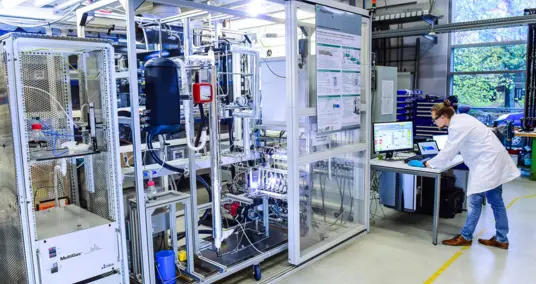
How fiber-optic temperature measurement helps develop Power-to-X technologies for the energy transition
Fiber-optic systems measure temperatures across fields, excelling where many sensors, compact size, and low thermal mass are needed—one 150 µm fiber can replace hundreds of sensors.

Continuous fiber optic strain measurement
Some bridges in Germany are aging and not designed for today’s increasing traffic loads. Authorities must now find cost-effective solutions to manage these existing structures.

Distributed fiber-optic temperature and strain measurement with extremely high spatial resolution
Sampling of the Rayleigh scattering along a length of optical fiber allows the realization of a distributed sensor system where every point along the fiber acts as a sensor. This novel method allows ...

Fiber Bragg Grating Sensors in Practice
Fiber-optic sensors are used in wind turbines not only for monitoring but also for control, for example, to adjust the rotor blades based on load measurements of the blades.
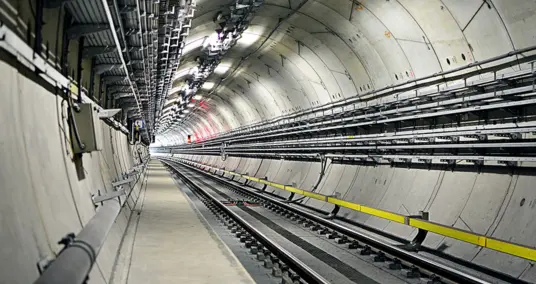
Distributed Fiber-Optic Sensing for Geotechnical Monitoring
Stones, blocks, steel, cement, concrete, and mortar—combined with large, heavy, clumsy, and noisy construction machinery—hardly make an ideal environment for a fragile glass fiber.

Fiber-Optic Temperature Measurement in Chemical Process Engineering
Conventional measurement methods quickly reach their limits when electromagnetic immunity, high measurement density, or chemically aggressive environments are required

Fiber-optic sensing in basic research
Friction clutches are used in millions of automobiles to transfer the engine’s torque to the drivetrain. However, the physical processes involved in frictional power transmission are still not completely u…
Related Products






Talk to our experts
Our experts are ready to support your projects with tailored measurement solutions or support you in measuring what matters — get in touch with us today.