
When the circuit board becomes audible
Whining or humming from power supplies, notebooks or mobile devices can originate from electrically excited capacitors and their coupling to the printed circuit board (PCB). This effect is known as “singing capacitors.” A typical case involves multilayer ceramic capacitors (MLCCs).
Class 2 MLCCs with a ferroelectric dielectric are particularly relevant. Under electrical excitation, for example from the voltage ripple, their ceramic can deform through inverse piezoelectric and electrostrictive effects. Which share dominates depends, among other things, on the material and the DC bias voltage.
Terminals and solder joints transfer the motion to the PCB. Its bending vibrations can then radiate audible sound, and any resonances that occur can amplify the sound radiation. Film capacitors can also cause noise, for example DC link capacitors in electric drives that are mechanically excited by voltage ripple.
With Polytec laser Doppler vibrometers, you characterize such noise-generating vibrations non-contact and with spatial resolution – whether directly on the component, on the surrounding PCB or on other adjacent structures. This gives you a basis for optimizing component selection, placement and PCB design in a targeted way.
Typical questions in development
A metrological investigation clarifies where the excitation acts, how the assembly responds and which change affects the relevant vibration. Typical questions include:
- Which capacitors and adjacent structures vibrate at the conspicuous frequencies?
- How are excitation and mechanical vibration response related?
- How are component motion and the structural response of the PCB related spatially?
- How do component selection, mounting, layout or drive signal change the structural response?
- How well does the simulation describe the measured amplitudes and deflection shapes?
If a microphone is used instead of a vibrometer, the exact spatial reference is lost. A microphone captures the sound pressure at the measurement location, where contributions from several radiating areas can overlap. For a structural root cause analysis, it therefore lacks a direct spatial reference.
What laser vibrometry contributes
Non-contact measurement. Unlike an accelerometer, the laser beam adds no mass to the test object. Even small, lightweight components can therefore be examined without any mass loading.
Targeted spatial reference. You place the measurement point directly on a capacitor, the PCB or a housing area. With suitable optics, the laser spot can be considerably smaller than the component, so that neighboring components can be examined separately.
Spatially resolved analysis. A scanning vibrometer measures the points of a measurement grid one after the other and displays amplitude distributions and the phase relationships between the measurement points. This shows how the components and the PCB vibrate relative to each other.
Visualizing vibrations. The software animates the measured deflection shapes. This makes it easier to align electronics development, acoustics and simulation.
Choosing the right optics. Depending on component size and the question at hand, standard, close-up or microscope optics are used. A microscope extension is not mandatory for an overall view of a PCB.
Examining capacitors and PCB together
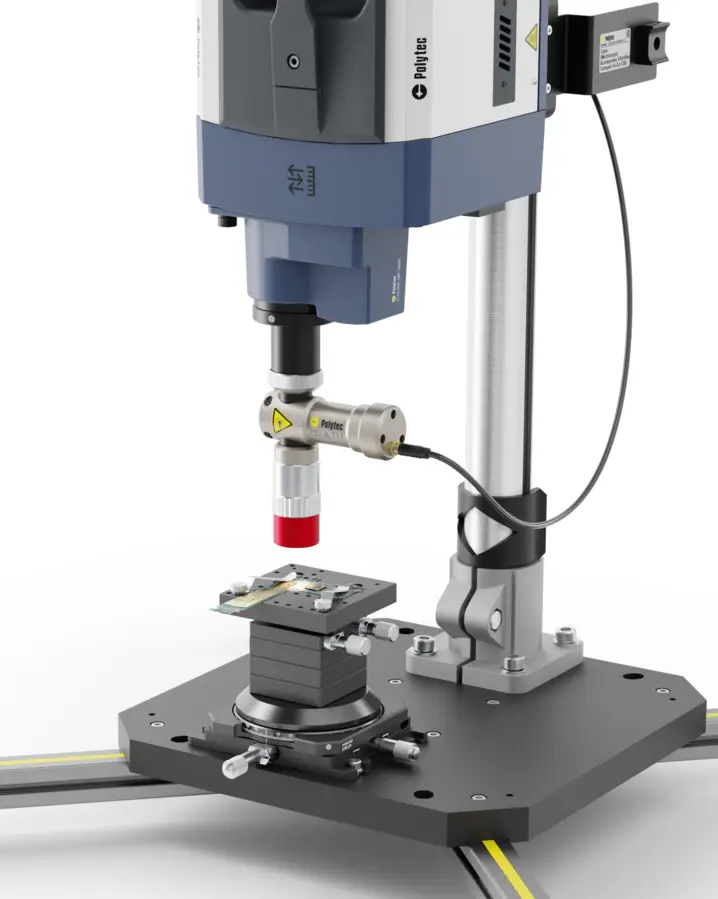
An application example from the Polytec Magazine shows a populated PCB with a group of SMD capacitors (surface-mounted devices). The measurement was performed with a PSV Scanning Vibrometer in a vertical setup. The figures show the spatial distribution qualitatively; frequencies and absolute values are not stated here.
Measurement setup
The sensor head is positioned vertically above the test object. Scanning mirrors direct the laser beam successively to the points of a measurement grid that covers both the PCB and the components. This arrangement is suitable for small, flat assemblies.
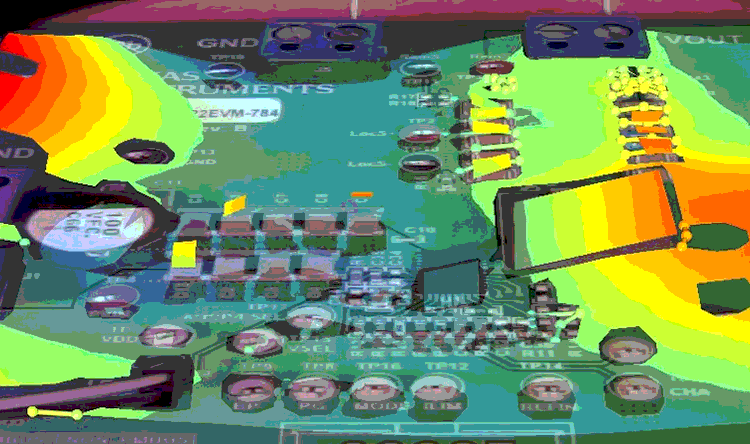
Capacitor group in the vibration image
The measurement grid is overlaid on the camera image of the PCB and shows the deflection at each measurement point. The group of SMD capacitors examined in the article is highlighted. This allows the motion to be assigned directly to individual components and areas of the PCB.
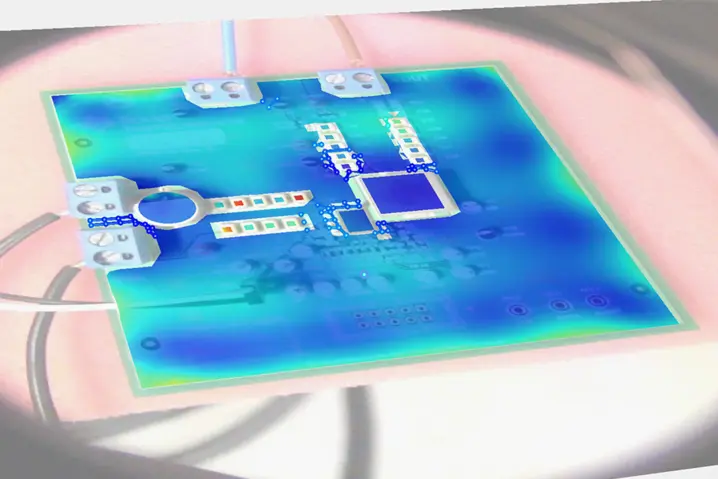
Spatial distribution of RMS vibration values
The full-field scan shows the root mean square (RMS) values of the vibration across the entire PCB. Individual components in the capacitor rows stand out in color from their surroundings, while large parts of the board show lower values.
Only this overall view reveals whether an anomaly remains localized or spreads across the PCB.
Related products
VibroScan QTec Xtra
VibroScan QTec Xtraは、振動を非接触、全視野、前例のない精度で測定する新しいソリューションです。画期的なマルチパス干渉計を備えたQTec® は、光学感度と干渉耐性の点で新しいスタンダードを確立しました。赤外線 (SWIR) レーザーをベースとするXtra は、最高の光学感度を特徴としており、要求の厳しい技術的表面でも高精度の測定を保証します。VibroScan QTec Xtraは、最大32MHzの信号発生器を内蔵しつつも、統合されたデータ取得により最大限の携帯性を保証します。
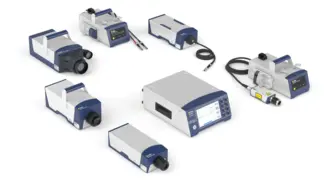
レーザドップラ振動計 VibroFlex
ポリテックのモジュール型レーザドップラ振動計 VibroFlex は、測定周波数帯域は最高 32 MHzまでで、測定要件に合わせて、測定レンジやセンサヘッドを選択できます。従来品に比べSNRを20dB向上させ、低ノイズ測定を実現する特許技術 QTecを搭載したセンサヘッドや、顕微鏡対物レンズ越しの測定、人の立ち入りが難しいなどの理由による遠隔測定、機械や部品など複雑形状の狭小部の測定など、それぞれの測定シーンに適したセンサヘッドをラインナップしています。ポリテックの レーザドップラ振動計は、製品の研究開発や、製造工程のインライン検査などに使用されており、簡単でスピーディ、高精度な測定を実現し、ものづくりの現場の製品化スピードと、品質管理向上に貢献しています。
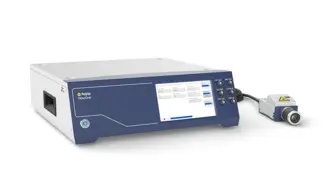
レーザドップラ振動計 VibroOne+
VibroOne レーザドップラ振動計は、これ一台で非接触振動計測がすぐに始められる、オールインワンモデルです。測定周波数帯域は最大24 MHzであり、内蔵 HD カメラオプションは、MEMS や、医療機器デバイス、生物などの微細構造を有するものの振動を計測する際に、特に便利です。レーザの照射位置を正確に視認さらに画像データとして保存することができます。

ご相談ください
当社のスペシャリストが、お客様のプロジェクトに合わせた測定ソリューションで支援いたします。あるいは、重要な要素の測定をサポートいたします。ぜひ、お気軽にお問い合わせください。