
When the circuit board becomes audible
Whining or humming from power supplies, notebooks or mobile devices can originate from electrically excited capacitors and their coupling to the printed circuit board (PCB). This effect is known as “singing capacitors.” A typical case involves multilayer ceramic capacitors (MLCCs).
Class 2 MLCCs with a ferroelectric dielectric are particularly relevant. Under electrical excitation, for example from the voltage ripple, their ceramic can deform through inverse piezoelectric and electrostrictive effects. Which share dominates depends, among other things, on the material and the DC bias voltage.
Terminals and solder joints transfer the motion to the PCB. Its bending vibrations can then radiate audible sound, and any resonances that occur can amplify the sound radiation. Film capacitors can also cause noise, for example DC link capacitors in electric drives that are mechanically excited by voltage ripple.
With Polytec laser Doppler vibrometers, you characterize such noise-generating vibrations non-contact and with spatial resolution – whether directly on the component, on the surrounding PCB or on other adjacent structures. This gives you a basis for optimizing component selection, placement and PCB design in a targeted way.
Typical questions in development
A metrological investigation clarifies where the excitation acts, how the assembly responds and which change affects the relevant vibration. Typical questions include:
- Which capacitors and adjacent structures vibrate at the conspicuous frequencies?
- How are excitation and mechanical vibration response related?
- How are component motion and the structural response of the PCB related spatially?
- How do component selection, mounting, layout or drive signal change the structural response?
- How well does the simulation describe the measured amplitudes and deflection shapes?
If a microphone is used instead of a vibrometer, the exact spatial reference is lost. A microphone captures the sound pressure at the measurement location, where contributions from several radiating areas can overlap. For a structural root cause analysis, it therefore lacks a direct spatial reference.
What laser vibrometry contributes
Non-contact measurement. Unlike an accelerometer, the laser beam adds no mass to the test object. Even small, lightweight components can therefore be examined without any mass loading.
Targeted spatial reference. You place the measurement point directly on a capacitor, the PCB or a housing area. With suitable optics, the laser spot can be considerably smaller than the component, so that neighboring components can be examined separately.
Spatially resolved analysis. A scanning vibrometer measures the points of a measurement grid one after the other and displays amplitude distributions and the phase relationships between the measurement points. This shows how the components and the PCB vibrate relative to each other.
Visualizing vibrations. The software animates the measured deflection shapes. This makes it easier to align electronics development, acoustics and simulation.
Choosing the right optics. Depending on component size and the question at hand, standard, close-up or microscope optics are used. A microscope extension is not mandatory for an overall view of a PCB.
Examining capacitors and PCB together
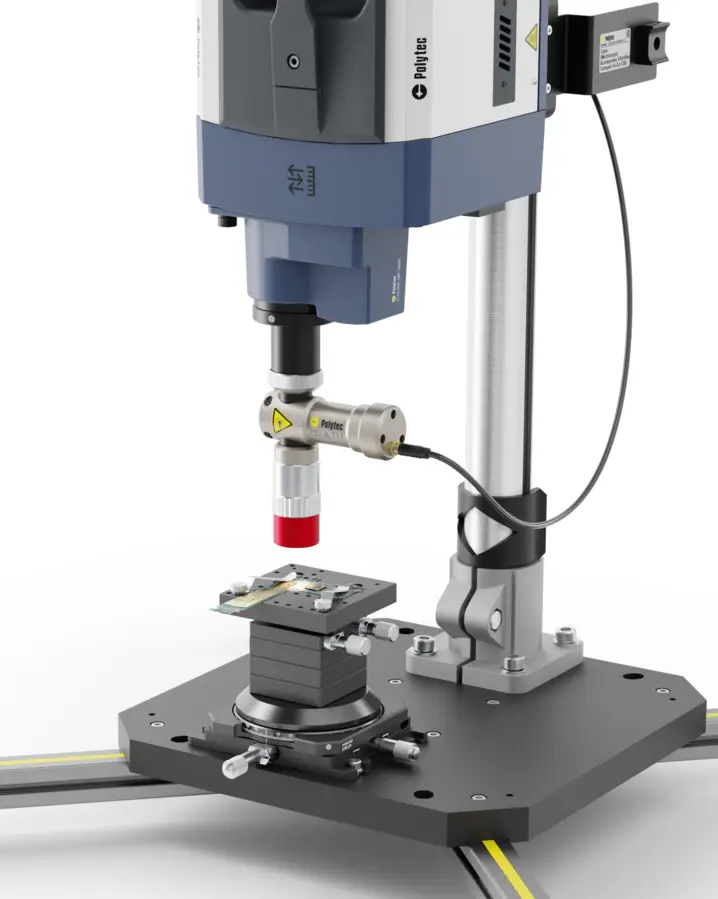
An application example from the Polytec Magazine shows a populated PCB with a group of SMD capacitors (surface-mounted devices). The measurement was performed with a PSV Scanning Vibrometer in a vertical setup. The figures show the spatial distribution qualitatively; frequencies and absolute values are not stated here.
Measurement setup
The sensor head is positioned vertically above the test object. Scanning mirrors direct the laser beam successively to the points of a measurement grid that covers both the PCB and the components. This arrangement is suitable for small, flat assemblies.
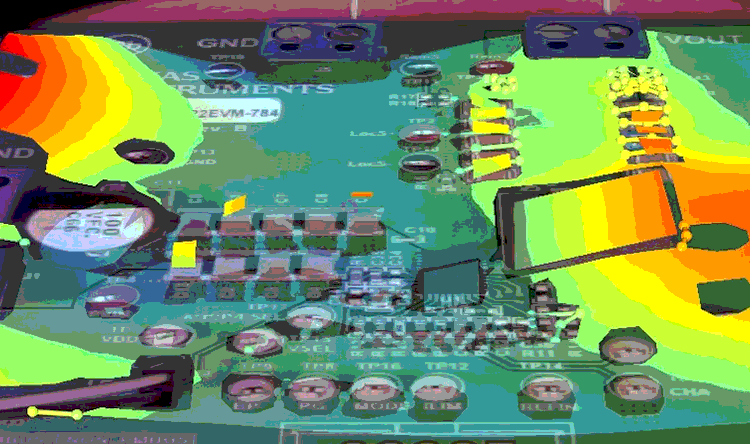
Capacitor group in the vibration image
The measurement grid is overlaid on the camera image of the PCB and shows the deflection at each measurement point. The group of SMD capacitors examined in the article is highlighted. This allows the motion to be assigned directly to individual components and areas of the PCB.
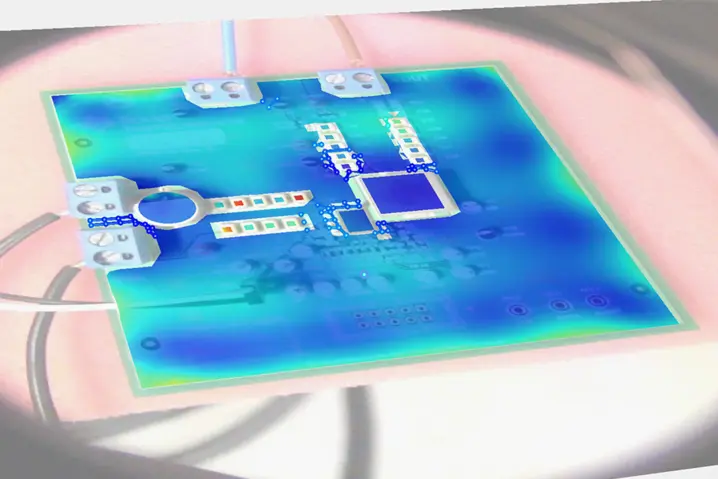
Spatial distribution of RMS vibration values
The full-field scan shows the root mean square (RMS) values of the vibration across the entire PCB. Individual components in the capacitor rows stand out in color from their surroundings, while large parts of the board show lower values.
Only this overall view reveals whether an anomaly remains localized or spreads across the PCB.
Related products
VibroScan QTec Xtra
Le VibroScan QTec Xtra mesure les vibrations d'une manière innovante - sans contact, sur champ complet et avec une précision inédite. Grâce à sa révolutionnaire interférométrie multi-chemins, QTec® établit de nouvelles normes en matière de sensibilité optique et d'immunité aux interférences. Le Xtra, basé sur un laser infrarouge (SWIR), se distingue par la plus haute sensibilité optique pour garantir des mesures extrêmement précises, même sur des surfaces techniques exigeantes. Le VibroScan QTec Xtra assure une portabilité maximale grâce à l'acquisition de données intégrée et au générateur de signaux jusqu'à 32 MHz.
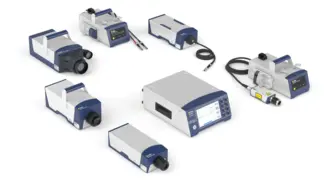
VibroFlex
Avec la gamme des vibromètres lasers VibroFlex, Polytec apporte une plus grande souplesse dans la mesure des vibrations à distance avec une famille de capteur optique modulable pouvant mesurer jusqu’à 32 MHz pour s’adapter à tous vos besoins. Nos vibromètres peuvent par exemple être utilisé en contrôle qualité sur ligne de production pour inspecter 100% de vos pièces avec efficience et fiabilité. Découvrez comment les interféromètres multicanaux brevetée QTec®, maintiennent un signal stable et améliore le rapport signal/bruit (SNR) de 20 dB pour des résultats clairs sans post-traitement.
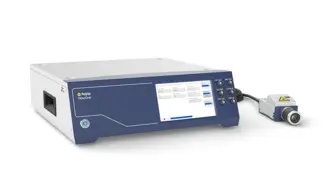
VibroOne+
Le vibromètre laser Doppler VibroOne® est la solution monobloc pour la mesure des vibrations sans contact jusqu'à 3 MHz. Il est spécialement conçu pour les configurations hermétiques, que ce soit dans les laboratoires de recherche, les environnements de production difficiles ou pour l'analyse sans contact de petits détails sur les microstructures ou les sondes biomédicales. La caméra HD + en ligne en option permet de positionner le laser avec précision et fournit une documentation de test appropriée.

Parlez à nos experts
Nos experts sont prêts à vous aider dans vos projets grâce à des solutions de mesure sur mesure ou à vous aider à mesurer ce qui compte vraiment. Contactez-nous dès aujourd'hui.