Introduction
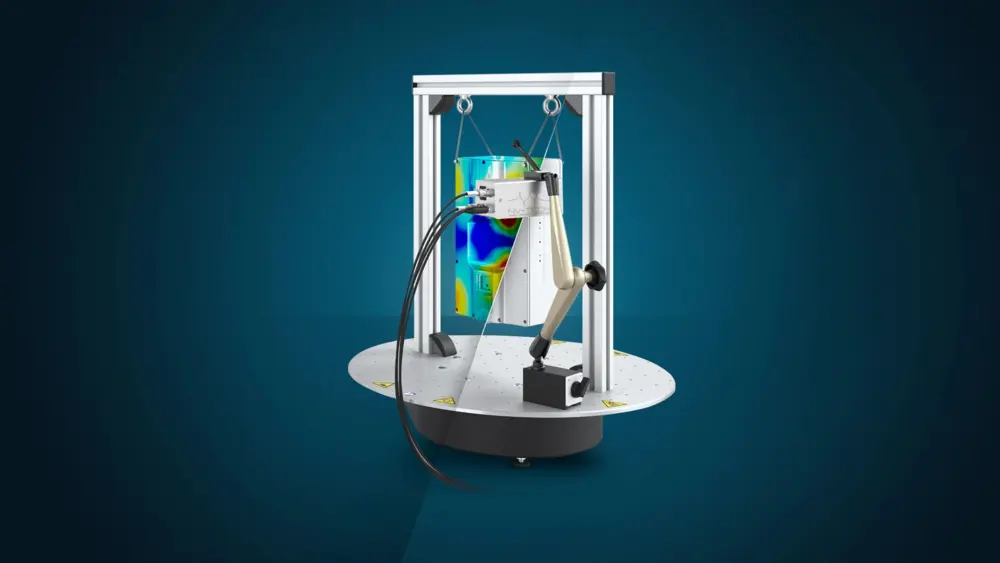
With RoboVib® Bench, Polytec presents an optical test station that automates experimental modal analysis from the ground up. Instead of laboriously reconfiguring sensor setups, a precision rotary tablecontrolled via Ethernetrotates the test object, enabling full-surface 3D vibration measurements from all directions. Combined with Polytec’s optical 3D scanning laser vibrometers, this creates a software-defined test that generates modal data for model validation in a reproducible and non-contact manner.
Maximum Productivity in the Measurement Laboratory
RoboVib® Bench is designed for test and CAE engineers who want to conduct modal analyses more efficiently, with higher spatial resolution and in closer alignment with FE models. Test geometries can be imported directly from CAE or captured via the integrated distance sensor on the scanning vibrometer, ensuring consistent coupling between simulation and experiment. The resulting 3D vibration datasets are suitable for model updating, correlation of natural frequencies and mode shapes, and acoustic optimization of small to medium-sized components.
Core Benefits for Modal Analysis
- Automated 360° Modal Analysis: The motorized rotary table automatically positions the test object in user-defined angular increments, allowing all viewing sides to be covered by a stationary 3D scanning laser vibrometer.
- Time Savings in the Laboratory: Manual repositioning of the sensor setup is eliminated; repeat tests and variant measurements can be set up quickly and run sequentially.
- Complete 3D Vibration Dataset: Individual measurement segments are “stitched” together in software and merged into a consistent dataset with high spatial resolution.
- CAE Support: Measurement points and test geometries are based on FE models, simplifying the correlation between simulation and measurement as well as subsequent model updates.
- Optical, Non-Contact Measurement Technology: The combination of 3D scanning laser vibrometer and rotary table eliminates mass loading effects, cabling effort, and typical contact errors of conventional sensor arrays.
Example Application
A typical use case is the modal analysis of a gearbox housing or an electronic control unit weighing up to 50 kg, which is first modeled in CAE, then mounted on the magnetic stainless steel carrier plate in RoboVib® Bench and subsequently scanned fully automatically in multiple rotational positions. The system generates a complete 3D dataset of mode shapes and natural frequencies, which flows directly into existing evaluation and CAE environments.
Technical Specifications
- Test object weight up to 50 kg; compact footprint for laboratory use.
- Motorized rotary table A-MTT-0050 with Ethernet control.
- Carrier plate made of magnetic stainless steel, Ø 600 mm, metric hole pattern 50 mm / M6, as well as an imperial variant.
- Full integration into PSV software from version 10.2.1; compatible with VibroScan QTec 3D, PSV QTec 3D, and PSV-500-3D.
- Features: automatic axis calibration via 3D alignment scan, geometry measurement, optimization of measurement positions based on laser angle of incidence, automatic scan, and measurement data stitching.
For more information, please visit: https://www.polytec.com/en/vibrometry/products/qtec-vibrometers/robovib-bench