Recording temperature profiles over long distances
In distributed measuring systems, no sensors need to be integrated into the fiber. Rather, backscattered light by the fiber is evaluated to obtain the desired temperature information. These systems are based on the evaluation of the Rayleigh scattering and enable the acquisition of temperature profiles along the glass fiber with resolutions in the millimeter range and up to 100 m long measuring sections. Thus, virtually every point of the glass fiber becomes the sensor. Conventional methods required hundreds or thousands of conventional point sensors with associated cables and immense installation effort.
For temperature measurement, the sensor fibers are usually performed in a capillary or a protective tube. Depending on the used interrogator (readout system) and the application, these can be inexpensive conventional standard glass fibers or can also be manufactured by Polytec according to your individual requirements.
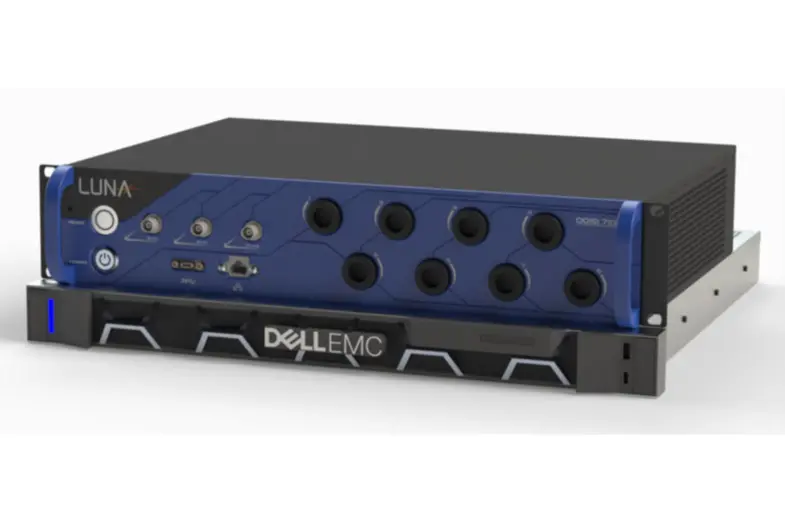
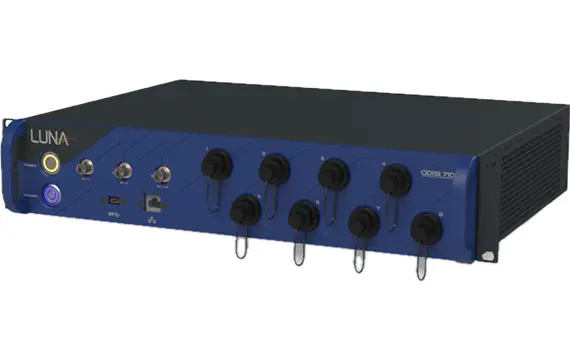
ODiSI 7000
- For temperature and strain measurement
- Fiber lengths up to 300 m, max. 200 m supply line and
100 m sensor length (guided in capillaries/protective tube) - maximum 8 channels (total of hundreds of thousands of measuring points)
- Standard temperature range -40 to +300 ° C
- Extended temperature range with special fiber from cryogenic temperatures to + 600 ° C
- Temperature resolution max. +/- 0.1 ° C
- Minimum sensor distance 0.65 mm
- Measuring speed up to 250 Hz
- Industrial-grade interrrogator in 19-inch rack
- High reliability and traceability
- Typical applications: Model and simulation validation, Temperature and load monitoring systems on the development of composite materials, fatigue tests and mechanical material structure monitoring
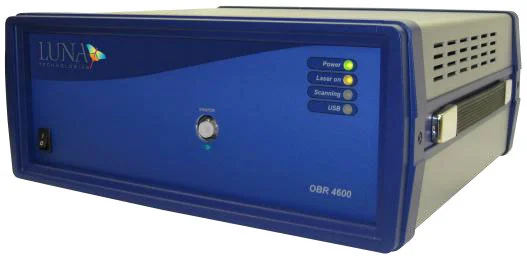
OBR 4600
- Optical backscatter reflectometer
- Fiber lengths up to 2 km
- Thousands of sensors along one fiber
- Standard temperature range -50 to +300 ° C
- Extended temperature range with special fiber from cryogenic temperatures up to +800 ° C
- Temperature resolution max. +/- 0.1 ° C
- Measuring speed up to 3 Hz
- Use of standard glass fibers
- Freely configurable sensor positions and lengths
- Recommended spatial resolution +/- 1 cm (min. 10 μm)