PMD and polarization emulation for realistic system testing
The polarization and PMD emulation systems enable controlled simulation of dynamic polarization effects in modern fiber-optic transmission systems. Defined PMD, DGD, and PDL conditions as well as controlled SOP variations support characterization and stress testing of optical components and high-speed transceivers. The solutions are particularly suited for laboratory, development, and automated production test environments.
Emulation systems
First Order PMD Source/Emulator
DGD-1000
The DGD-1000 is a first-order polarization mode dispersion (PMD) source designed to generate controlled amounts of differential group delay (DGD). The instrument provides precise DGD simulation up to 400 ps without introducing second-order PMD effects.
In high-speed fiber-optic transmission systems, polarization mode dispersion can significantly impact signal integrity and transmission performance. The DGD-1000 enables accurate and repeatable generation of both low and high DGD values, supporting the characterization and validation of high-speed optical transceivers under defined PMD conditions.
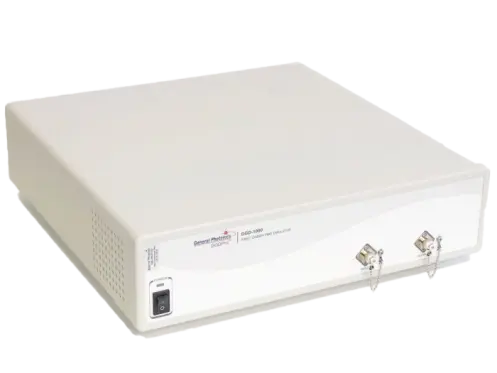
Within its specified operating range, both the generated DGD and the polarization dependent loss (PDL) remain highly stable over time and across wavelength. Multiple instrument versions are available to address different wavelength requirements and DGD ranges.
- Large DGD range (up to 400 ps)
- Accurate at both low and high DGD values
- Output DGD and and state of polarization (SOP) stable over time
- Output DGD is wavelength insensitive over the specified band
- Very low IL and PDL variability over output DGD range
Multifunction Polarization Controller
MPC-202
The MPC-202 is a multifunction polarization controller designed for high-speed scrambling and dynamic polarization transition applications. The instrument was developed specifically for stress and performance testing of coherent optical receiver systems.
By combining fiber-squeezer polarization control technology with proprietary control algorithms, the MPC-202 supports a broad range of polarization management and emulation functions. These include polarization scrambling, controlled polarization transitions, and additional operating modes for dynamic state-of-polarization variation.
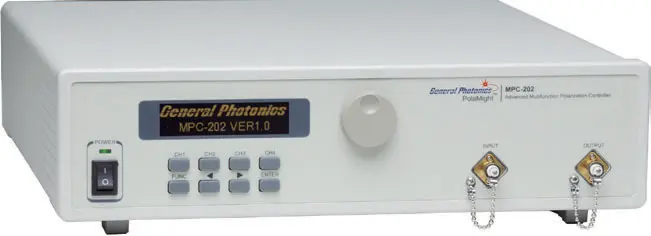
For polarization tracking speed and receiver recovery time testing, the system provides square-wave transition and scrambling functions with polarization slew rates of up to 360 krad/s. In addition, the MPC-202 supports manual polarization control, modulation functions, and other scrambling modes similar to those available in the MPC-201.
- Fast polarization variation
- Multiple polarization control and scrambling functions
- Easy to use
- Low IL, PDL, PMD, and activation loss (AL)
PDL Source/Emulator
PDLE-101
The PDLE-101 is a polarization dependent loss (PDL) source designed for generating controlled PDL values in fiber-optic test and characterization applications. The instrument creates variable PDL levels by selectively attenuating one polarization component of the input optical signal.
The system supports PDL generation up to 20 dB with a resolution of 0.1 dB, making it suitable for PDL tolerance testing of optical components and transmission systems. In addition, the PDLE-101 can generate dynamic PDL profiles with user-defined ranges, waveforms, and transition speeds.
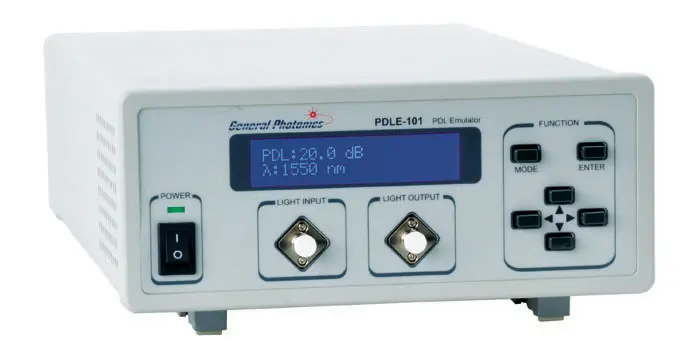
This enables the instrument to be used for polarization tracking performance evaluations, including recovery time and tracking speed tests in polarization-sensitive systems.
- Large PDL range: 20 dB
- High resolution
- Low residual PMD
- PDL scanning functions
PMD Emulator/Source
PMD-1000
The PMD-1000 is a digital polarization mode dispersion (PMD) source designed for deterministic generation of both first-order and second-order PMD effects. The instrument supports differential group delay (DGD) values up to 180 ps and second-order PMD (SOPMD) values up to 8100 ps².
PMD generation is based on birefringent crystal elements combined with ternary magneto-optic rotators. With switching times as low as one millisecond and a quasi-continuous operating mode, the system enables fast and repeatable PMD variation. First-order PMD and wavelength-independent second-order PMD can be generated independently for comprehensive PMD condition emulation.
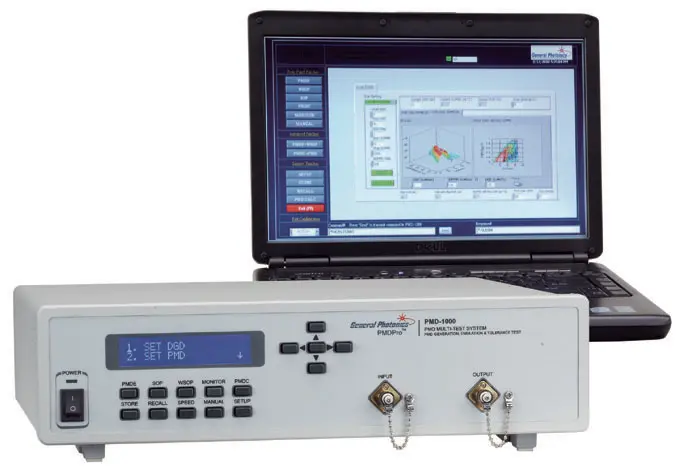
In addition to static DGD and SOPMD settings, the PMD-1000 supports continuous PMD traces, grid-based PMD scans, and statistical PMD emulation. The instrument also integrates a polarization controller and two polarimeters positioned before and after the PMD generation stage.
The built-in polarization controller can scramble the input polarization to reduce sensitivity to input SOP conditions. For single-polarization signals, the system additionally supports automatic worst-case PMD adjustment, optical PMD compensation, and deterministic polarization control functions such as SOP trace generation and polarization stabilization.
- Generates 1st and 2nd order PMD
- Rapid PMD switching (1 ms)
- Polarization scrambling
- PMD statistical emulation