Precision polarization control with ultra-low optical loss
Accurate polarization control and reliable analysis methods are essential for the characterization of modern fiber-optic components and transmission systems. The presented solutions support polarization state adjustment, modulation, and analysis, as well as the investigation of polarization-dependent effects in laboratory, development, and production environments. Typical applications include PDL and PMD characterization, polarization state analysis, and automated testing in high-speed optical systems.
Control & analysis systems
Multifunction Polarization Controller
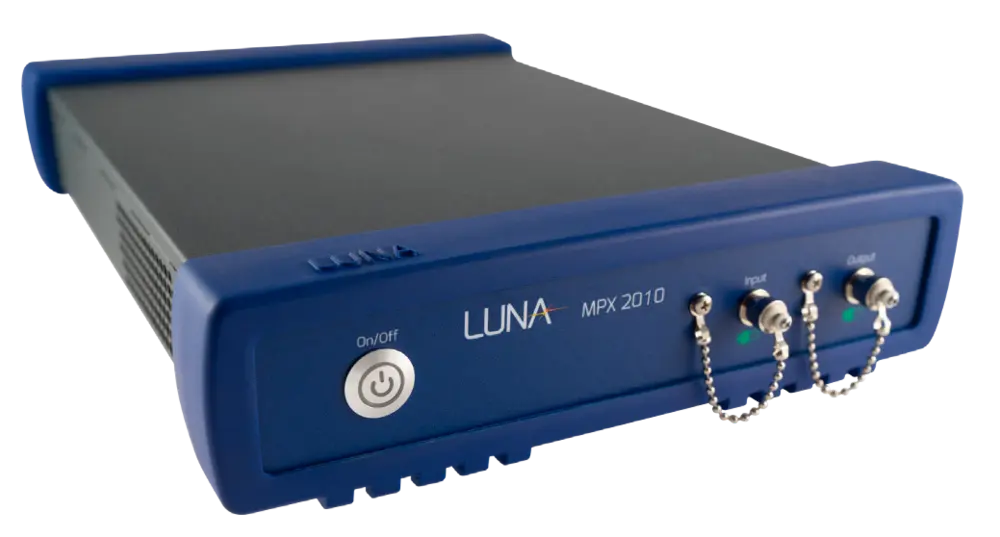
MPX 2010
The MPX 2010 is a low-loss polarization controller and scrambler designed for use in manufacturing and automated test applications. The system enables polarization scrambling at speeds of up to 40,000 state-of-polarization (SOP) changes per second.
Thanks to its fully fiber-optic design, insertion loss (IL), polarization-dependent loss (PDL), and polarization mode dispersion (PMD) are minimized. This makes the MPX 2010 suitable for precise polarization control in a wide variety of applications, such as emulating SOP changes, recirculating loop studies, PDL measurements, or polarization-related system tests.
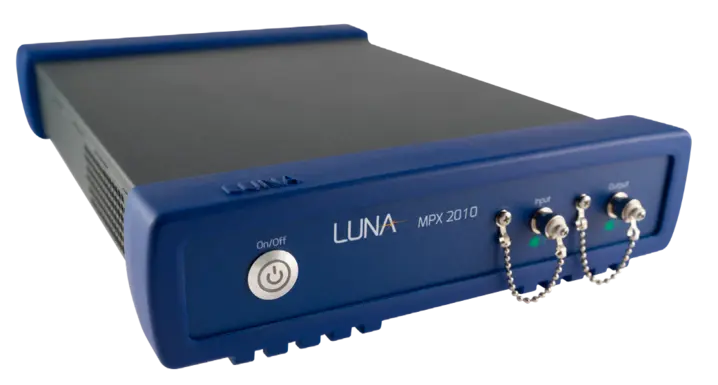
The platform covers the wavelength range from 1260 nm to 1620 nm across the O, C, and L bands in a single device version and supports optical powers up to 1 watt. Additionally, a variant is available for applications in the range from 980 nm to 1310 nm.
As the successor to the MPC-201, the MPX 2010 offers improved performance in a compact design, making it particularly suitable for integration into production and automated test environments.
- Multiple operation modes
- Low IL, RL, PDL, PMD and activation loss (AL)
- Improved GUI software interface and communication speeds
- USB 2.0, Ethernet 100BASE-TX
- SCPI command, C/C++ API, PC GUI
- Trigger in/out
Polarization extinction ratio meter (ERM)
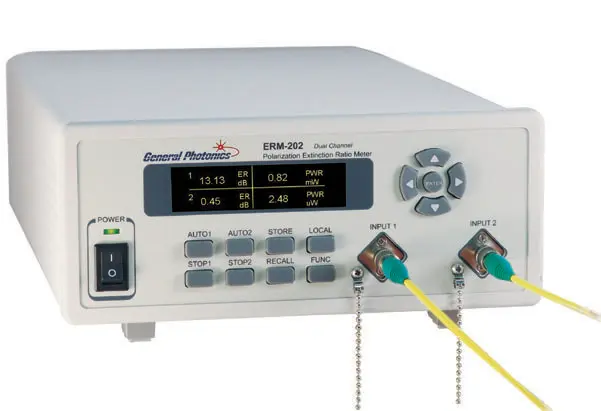
ERM-202
The ERM-202 is a polarization extinction ratio (PER) meter based on a rotating polarizer design and is offered in either a single-channel or dual-channel configuration.
By combining low-noise electronics with a precision stepper motor, the instrument provides a PER dynamic range of up to 50 dB and an angular resolution of 0.06°. In a single measurement process, the ERM-202 determines the PER, optical output power, and polarization axis angle of the device under test (DUT).
The dual-channel model additionally supports measurements of the power distribution between two polarization-maintaining (PM) outputs. This is particularly useful for components such as Y-branch fiber gyro integrated optical circuits (IOC), PM couplers (PMC), and polarization beam splitters (PBS).
- PER measurement range >50 dB
- Angle resolution 0.06°
- Simultaneous PER and power ratio measurement (dual channel)
Log detector
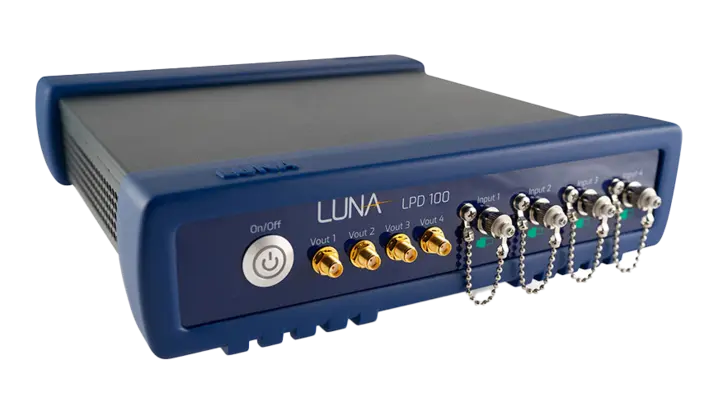
LPD 100
The LPD 100 multiport log detector is a photodiode amplifier developed for the detection of very low optical power levels below -90 dBm.
The system converts low-level optical signals into a linear logarithmic electrical output signal and is available in two- or four-channel configurations. Thanks to its wide dynamic range, the LPD 100 is well suited for closed-loop measurement and control applications that require precise optical power monitoring.
Typical use cases include polarization tracking systems, especially applications where the control loop must reliably detect and maintain a minimum optical power level. In such scenarios, generating a stable and accurate feedback signal can be particularly demanding.
- Calibrated from < -85 dBm to >10 dBm.
- Response greater up to 4 MHz
- Single buffered analog (SMA) voltage output
- Compact size
- Modular Design
Polarization dependent loss (PDL) multimeter
PDL-201
The PDL-201 is designed for the measurement of polarization dependent loss (PDL), insertion loss (IL), and optical power in optical components and devices.
Using a patented maximum/minimum search method compliant with TIA/EIA-455-198, the instrument determines PDL, IL, and optical power simultaneously within approximately 30 ms. Compared to systems based on polarization scrambling, the max-min measurement approach provides reliable results across both low and high PDL ranges. In contrast to Mueller Matrix-based instruments, the PDL-201 also supports a broad wavelength range without requiring wavelength-specific calibration.
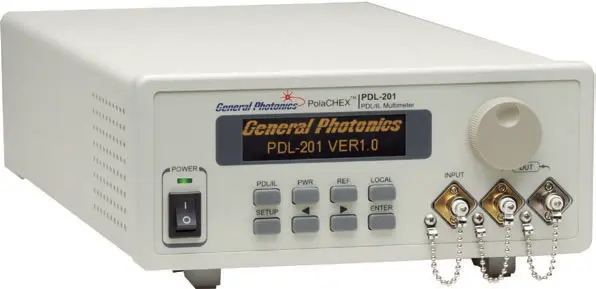
Its high measurement speed, combined with remote control capabilities, makes the PDL-201 suitable for integration into automated or semi-automated test environments, particularly in combination with tunable laser sources.
- 30 ms measurement speed
- Wide wavelength range
- High PDL accuracy
- OLED display and analog output
High-speed polarimeter
POD 2000
The POD 2000 is a DSP-based polarimeter developed for high-speed polarization measurement, analysis, and monitoring applications.
Using four simultaneous measurement channels, the instrument captures all four Stokes parameters in real time and determines both the instantaneous state of polarization (SOP) and the degree of polarization (DOP) of the incoming optical signal.
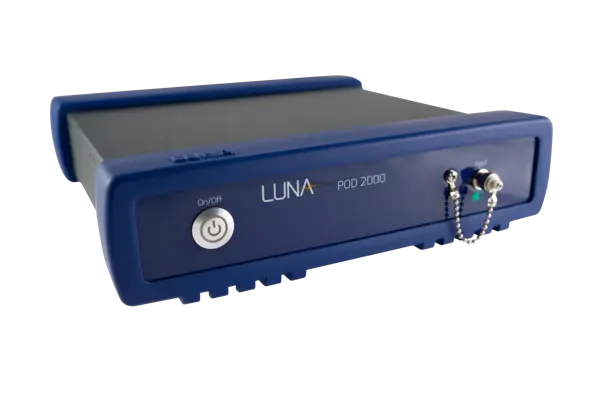
Data transfer to a computer is handled via a USB 2.0 interface, enabling fast acquisition and evaluation of polarization data. With sampling rates of up to 100 kS/s, the POD 2000 is suitable for monitoring rapid polarization variations. In addition, a standard 100BASE-TX Ethernet interface is available for remote measurement and instrument control.
The system software includes a graphical user interface for real-time visualization of polarization behavior. Measurement data can be displayed either in a Poincaré sphere view for SOP trajectory analysis or in an oscilloscope-style view for observing polarization changes over time.
- High speed, SOP/DOP measurement with 100Khz date update rate
- High accuracy
- Dynamic range -45 to 5 dBm
- None Stop or Continuous measurement as high as 100KHz update rate.
- USB 2.0, Ethernet 100BASE-TX
- SCIP command, C/C++ API, PC GUI
- Trigger in/out