Industrial layers & coatings
Coatings are ubiquitous in industry. They are essentially assigned two main functions: meeting decorative (aesthetic) or functional requirements.
In both cases, layer thickness is a critical quality parameter. For visual requirements, a coating that is too thin can cause the substrate to show through, meaning the visual appearance no longer meets the defined specifications. Functional coatings are also defined by their thickness—for example, anti-corrosion coatings cannot fully provide their protective effect if applied too thinly.
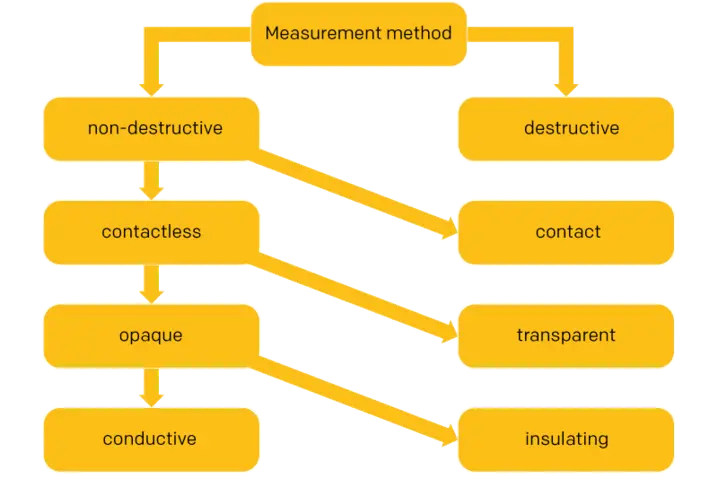
From an economic perspective, in addition to insufficient coating thickness—which leads to quality losses, scrap, or complaints—so-called overcoating must also be avoided. Coating thickness can be controlled using various methods, which can primarily be divided into the following categories:
Destructive or semi-destructive measurement methods, such as cross-section analysis, are not covered here. Similarly, contact or tactile measurement methods are not discussed further in this section and are mentioned in the diagram solely for the sake of completeness.
Optical measurement techniques are classified according to transparent, partially transparent, and opaque coatings. Measurement techniques for opaque coatings can be differentiated based on the coating’s conductive and insulating properties.
Optical and radiation-based methods for measuring layer thickness
| Coating Thickness Measurement Technique | Best Suited For | Coating Type | Typical Thickness Range | Typical Environment |
|---|---|---|---|---|
| Spectral Reflectometry | Thin optical coatings, simple multilayer coatings | Transparent / semi-transparent | ~ nm – µm | Lab / Inline |
| Ellipsometry | Ultra-thin coatings, precision optical coatings | Transparent | ~ sub nm – nm* | Lab |
| White Light Interferometry (WLI / CSI) | High-precision surface topography and transparent coatings | Transparent / semi-transparent | ~ nm – µm | Lab |
| Optical Coherence Tomography (OCT) | Multilayer coatings (e.g. paint, polymers) | Transparent / scattering | ~ µm – mm | Lab / Inline |
| Chromatic Confocal Sensors | Structured surfaces, varying coating thickness | Transparent / opaque | ~ µm – mm | Inline / Production |
| Terahertz (THz) Thickness Measurement | Thick coatings and multilayer systems (paint, plastics) | Non-conductive (dielectric) | ~ 10 µm – mm | Inline / Lab |
| X-ray Fluorescence (XRF) | Metal coatings (e.g. plating thickness measurement) | Metallic | ~ nm – µm | Production / Lab |
| Photothermal Thickness Measurement | In-process coatings, including wet coatings | Organic / functional | ~ µm – mm | Inline / Production |
| Hyperspectral Imaging (HSI) | Area-based coating thickness and uniformity analysis | Material-dependent (optically active) | ~ nm – µm | Inline / Lab |
*sub-nm refers to thicknesses below 1 nanometer
Technical Principles of layer Thickness Measurement
| Measurement Technique | Physical Principle | Primary Measurement Signal | Material Dependency | Typical Accuracy | Key Advantages / Notes |
|---|---|---|---|---|---|
| Spectral Reflectometry | Broadband optical interference | Reflection spectrum (interference fringes) | Transparency, refractive index | ~ nm | Model-based analysis required |
| Ellipsometry | Polarization state change upon reflection | Amplitude and phase shift (Psi, Delta) | Optical constants (n, k) | ~ sub-nm – nm* | Highly sensitive, strongly model-dependent |
| White Light Interferometry (WLI / CSI) | Coherence interferometry | Interference signal along optical axis | Reflectivity, transparency | ~ nm | Combines surface topography and coating thickness |
| Optical Coherence Tomography (OCT) | Low-coherence interferometry (depth-resolved) | Time-of-flight / interference signal | Scattering, refractive index | ~ µm | Non-contact multilayer thickness profiling |
| Chromatic Confocal Sensors | Chromatic aberration (wavelength-dependent focus) | Spectral peak position (focus point) | Refractive index | ~ sub-µm – µm | Robust for rough and industrial surfaces |
| Terahertz (THz) Thickness Measurement | Electromagnetic pulse time-of-flight | Echo time delay | Dielectric properties | ~ µm – 10 µm | Measures multilayer coatings without contact |
| X-ray Fluorescence (XRF) | Excitation and emission of characteristic X-rays | Element-specific X-ray intensity | Elemental composition | ~ nm – µm | Standard for metal coating thickness measurement |
| Photothermal Thickness Measurement | Transient thermal response after optical excitation | Temperature vs. time signal | Thermal properties | ~ µm | Works on wet and uncured coatings |
| Hyperspectral Imaging (HSI) | Spectral imaging across surface area | Spectral signature per pixel | Optical properties | Application-dependent | Enables full-field coating thickness mapping |
*sub-nm refers to thicknesses below 1 nanometer
Explanation of measurement techniques
Below you'll find a concise explanation of the most relevant non-contact coating thickness measurement techniques and their underlying principle.
Spectral Reflectometry
Spectral reflectometry analyzes the interference of broadband light reflected from thin films. The resulting interference pattern in the reflection spectrum is used to determine the optical thickness of transparent or semi-transparent coatings with high precision.
Ellipsometry
Ellipsometry measures changes in the polarization state of light upon reflection at oblique incidence. By analyzing amplitude and phase shifts, both coating thickness and optical constants can be determined with sub-nanometer resolution, typically using model-based evaluation.
White Light Interferometry (WLI / CSI)
White light interferometry uses low-coherence light to generate interference signals along the optical axis. It enables highly precise surface topography measurements and can determine the thickness of transparent layers simultaneously.
Optical Coherence Tomography (OCT)
OCT is based on low-coherence interferometry and measures the time delay of reflected light. This allows non-contact depth profiling of multilayer systems, even in scattering materials such as paints or polymers.
Chromatic Confocal Sensors
Chromatic confocal sensors use wavelength-dependent focusing of white light. Only the wavelength in focus at a surface is detected, enabling precise distance measurement and thickness determination, even on rough or structured surfaces.
Terahertz (THz) Thickness Measurement
Terahertz systems emit short electromagnetic pulses that penetrate dielectric materials. Reflections at layer interfaces create time-delayed echoes, allowing the thickness of individual layers in multilayer systems to be measured without contact.
X-ray Fluorescence (XRF)
XRF excites atoms using high-energy X-rays, causing them to emit characteristic fluorescence radiation. By analyzing element-specific intensities, the thickness of metallic coatings can be determined accurately.
Photothermal Thickness Measurement
Photothermal methods use short optical excitation to heat the coating surface. The resulting thermal response over time depends on the coating thickness and material properties, enabling measurement even for wet or uncured coatings in production.
Hyperspectral Imaging (HSI)
HSI captures a full optical spectrum for every pixel in an image. By analyzing spectral features across a surface, coating thickness variations and inhomogeneities can be visualized and evaluated over large areas.