The need for metamaterials
Vibroacoustic metamaterials can reduce unwanted noise and vibration in a targeted way — especially where conventional damping adds too much weight, takes up too much space, or is not effective enough in the relevant frequency range.
But to work reliably, metamaterials must be designed for a clearly defined vibration problem and validated on the real component. Polytec laser vibrometers support this process by measuring vibration behavior without contact. This helps engineers compare simulation and reality, identify resonances and stopbands, and optimize prototypes faster.
The result: laser vibrometry becomes a practical tool for turning promising metamaterial concepts into reliable vibration-control solutions.
Typical practical use cases
Vibroacoustic metamaterials can support many applications where vibration reduction and low weight are both important.
- In vehicle development, they can help reduce noise and vibration without adding heavy damping material.
- In aerospace, they can support lightweight vibration control in satellite or support structures.
- In mechanical engineering, they can improve precision and reduce unwanted excitation.
- In building and room acoustics, they can contribute to targeted sound insulation or sound guidance.
- In medical and precision technology, they can help control vibration in sensitive components.
The benefit is always similar: the structure is designed to solve a defined vibration problem instead of treating it afterwards with additional mass.
The tricky thing for engineers
Vibroacoustic metamaterials are not standard damping materials. They are specially designed structures that reduce, block, or redirect vibrations in defined frequency ranges. This makes them especially useful when vibration control is needed, but additional mass, space, or material use must be kept to a minimum.
For practical development, the key question is not simply:
"Can a metamaterial dampen vibration?"
The better — and more relevant — question is:
"Can this specific structure solve this specific vibration problem under real operating conditions?"
That is why measurement is essential. Simulation helps to design the concept, but laser vibrometry shows how the manufactured component actually behaves.
Elaborate potential problems with metamaterial components
The development of a metamaterial should begin with the problem it needs to solve. Key questions include:
- What frequency range causes the problem?
- Where does the vibration occur?
- How does it affect comfort, precision, durability, or safety?
- How much damping is required?
- How much additional weight or space is acceptable?
These answers define the target for the metamaterial design. They also provide the basis for later validation.
Design the structure for the target frequency range
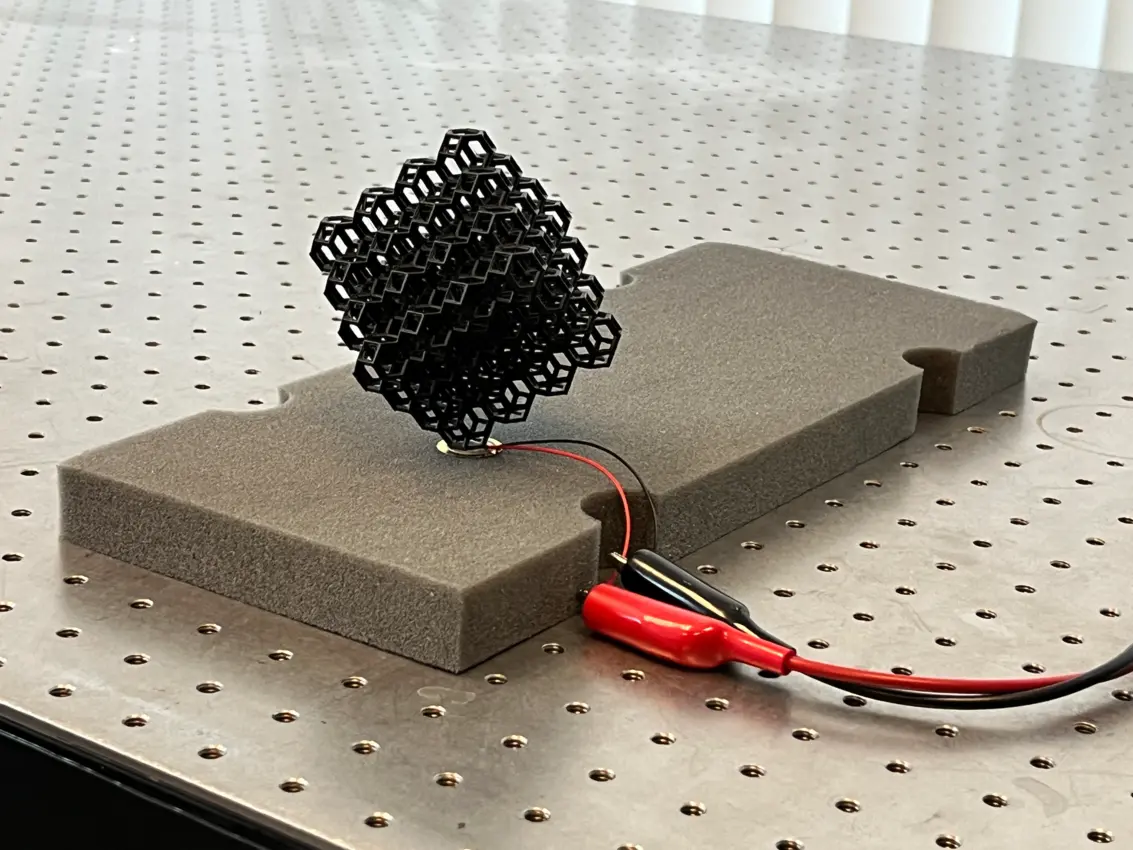
Once the potential vibration problems are identified, the metamaterial can be designed accordingly. Depending on the application, this may involve periodic structures, local resonators, lattice geometries, or more complex 3D-printed designs.
The goal is not simply to add damping. The goal is to influence vibration behavior in a defined way — for example by creating a stopband, reducing a resonance, or limiting wave propagation through a component.
This targeted design approach is what makes metamaterials attractive for lightweight construction. They can reduce vibration without relying mainly on mass.
Improve product quality and design systematic by validating your simulations
Simulation is an important part of metamaterial development, but it is not enough. Small differences between the simulated and manufactured structure can change the result. Typical influencing factors include:
- Manufacturing tolerances
- Material variations
- Surface quality
- Mounting and boundary conditions
- Temperature or load changes
- Aging and wear in long-term applications
For this reason, every prototype should be experimentally validated. This is where laser vibrometry becomes a practical development tool.
Measure the real dynamic behavior
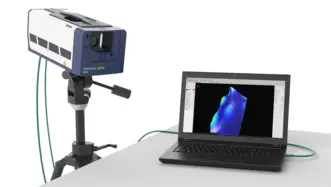
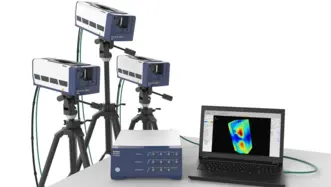
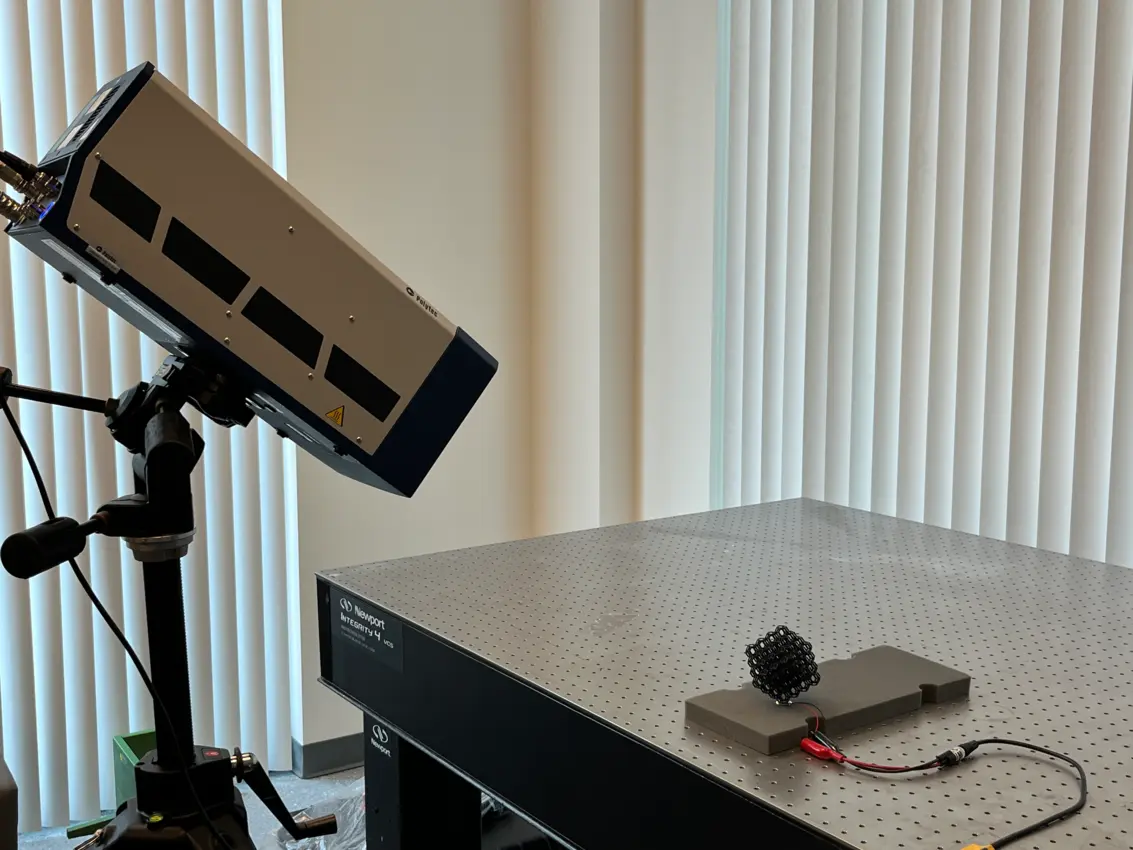
Polytec laser vibrometers measure vibration without contact. This is important because contact sensors can influence lightweight, small, or sensitive structures. With laser vibrometry, engineers can check:
- Whether the target frequency range is actually damped
- Where resonances and mode shapes occur
- How vibration waves travel through the structure
- Whether a stopband appears as expected
- How strongly the structure attenuates vibration
- How closely the real component matches the simulation
The result is not only a measurement value. It is a clearer understanding of how the metamaterial behaves in reality.
Pay attention to difficult surfaces
Metamaterial structures can be challenging to measure. They may be dark, rough, highly structured, reflective, or very small. 3D-printed lattice structures, in particular, often create difficult optical conditions.
Polytec’s QTec® Multi-Path Interferometry helps in these cases by evaluating several optical signals at the same time. This improves signal quality, reduces measurement dropouts, and can shorten measurement time.
Use the measurement data to improve the design
Measurement should be part of an iterative process:
- Define the vibration problem.
- Simulate the metamaterial design.
- Manufacture the prototype.
- Measure the vibration behavior.
- Compare measurement and simulation.
- Adapt the geometry, resonator layout, or material.
- Validate the improved design again.
This loop helps development teams move faster from concept to reliable function. It also reduces the risk of discovering problems too late in the project.
How to start with vibration analysis for your project?
Not every project requires an immediate investment in a complete measurement system. Especially in research projects, feasibility studies, or early prototype development, flexible access to measurement equipment can be more practical.
Polytec supports this with different options, including measurement services, where experienced specialists perform the measurement, and rental systems, which allow teams to run analyses locally at their own site.
This makes it easier to validate ideas, compare designs, and generate reliable data without high upfront investment.
Measure what matters
Vibroacoustic metamaterials can be a powerful solution for vibration and noise reduction in lightweight structures. But their performance depends strongly on geometry, manufacturing quality, and installation conditions.
For practical development, the key is a clear process:
- Understand the vibration problem.
- Design the metamaterial for the target frequency range.
- Validate the real behavior with non-contact laser vibrometry.
- Use the measurement data to improve the design.
This is how promising metamaterial concepts become reliable, application-ready vibration-control solutions.