The IVS-500 as the perfect sensor for the vibro-acoustic end-of-line test
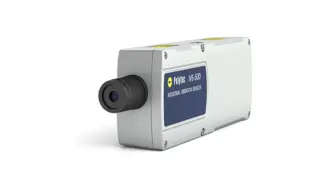
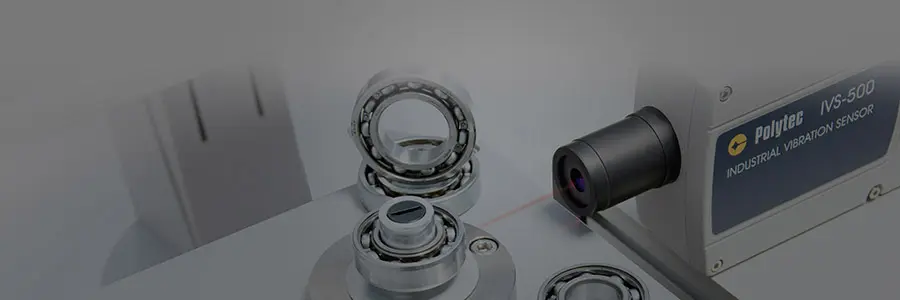
The IVS-500 Industrial Vibration Sensor from Polytec is a dedicated and flexible measuring device for the vibroacoustic end-of-line test. With customer requirements of quiet products as quality indicator, the requirements regarding sensor solutions for the underlying production testing increase, too. Especially in noisy production environment, manufacturers face the challenge of selecting a suitable, efficient and reliable sensor for troubleshooting, acoustics testing and noise analysis.
Why are more and more laser Doppler vibrometers used in production for vibration measurement?
- 100% error-free production
- For years, there has been a trend in the automotive sector, in household devices and consumer electronics products to constantly reduce disturbing noise in order to make products more and more quiet and improve acoustic comfort. But not only the acoustic comfort is important, also the quality and thus the 100% error-free production must of course be guaranteed for all products.
- Prevent total failures
- Component defects that produce sounds inaudible to humans can also lead to total failures in the field. With the IVS-500 this can be prevented.
- Analyze measurement data
- Vibration measurements allow on the one hand to evaluate the acoustic behaviour at the end of the production and on the other hand to detect manufacturing defects by a specific analysis of the vibration data and to assign them to the defect.
Acoustic quality control with laser precision
Why laser Doppler vibrometry?
- Contact-free & without causing interaction
- The object to be measured is not influenced by an additional mass or force during the measurement. The vibrations to be measured are therefore not distorted.
- Very high frequency ranges
- Measurements up to 100kHz are possible with the IVS-500 easily. This is essential for finding complex manufacturing defects at higher RPM.
- No mechanical infeed device
- The non-contact measurement also eliminates the need for a mechanical infeed device, which reduces the effort of integrating the laser vibrometer into the production line. This allows very fast cycle times and short test cycles.
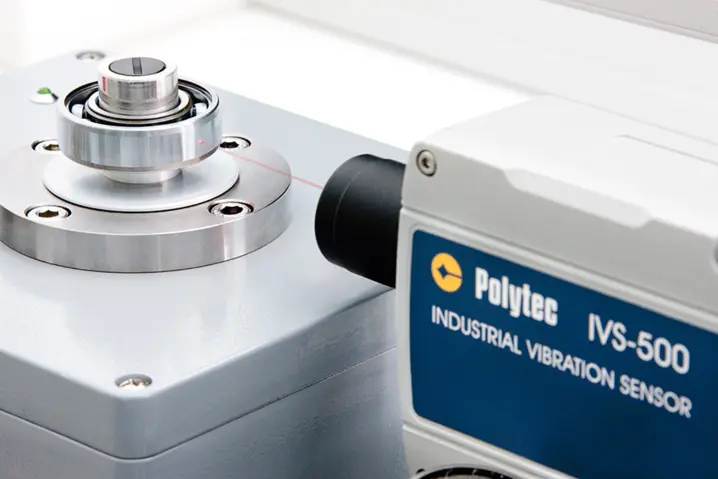
Due to the measurement of surface vibrations, the digital or analog data transfer and the very high resolution, the laser vibrometer is extremely flexible and can be used in various and also difficult test applications. Measurements can also be carried out in noisy production environments.
Which sensor is the right one for my noise and vibration test?
For the vibro-acoustic end-of-line test, practically 3 sensor types are possible:
- Microphone
- Accelerometer
- Laser vibrometer
Laser triangulation is another optical measurement technique. Due to its low resolution and bandwidth it is not considered.
Get in touch with our IVS experts
Get in touch with our IVS experts
Successful vibration measurement in industrial applications
With the industrial vibrometer IVS-500 you can carry out fast vibroacoustic quality tests, structure-borne sound analysis and reliable pass/fail evaluations. It measures in challenging industrial environments, on almost all surfaces as well as contactless and therefore non-wearing. By eliminating pseudo rejects in the production and assembly process, you optimise your costs and profits.
In the following you will find tutorial videos which explain the installation, configuration and the most important features of the IVS-500 in detail in nine chapters.
Chapter 1: Choosing the right hardware
Duration: 1:49 minutes
Polytec offers different versions of the IVS-500. It is important to find the right choice regarding maximum frequency bandwidth, vibration velocity and focus type – manual or remote focus.
Chapter 2: Electrical Connection
Duration: 2 minutes
The IVS-500 can be connected either via a junction box provided by Polytec or directly via an open-ended cable to the control cabinet by skilled personnel in production. Both are provided by Polytec. All cables and functionalities of the junction box are presented here.
Chapter 3: Accessories for the IVS-500
Duration: 5:30 minutes
With the appropriate accessories, every installation can be simplified and every measurement situation can be carried out in the best possible way. Learn more about Polytec accessories for the IVS-500.
Chapter 4: Test bench integration
Duration: 3:45 minutes
To integrate the IVS-500 optimally into a test bench, we explain the best way to proceed and give tips for setup. Thereby we show how the interfaces are connected correctly.
Chapter 5: Isolate unwanted vibrations
Duration: 1:05 minutes
The trend is towards ever more quiet products. Thus, the vibrations to be measured vibro-acoustically are also becoming smaller and smaller. External disturbances such as vibrations generated by machines in production can then influence the measurement. Here we show you how to solve such problems with simple means.
Chapter 6: Vibrometer Panel Software
Duration: 3:40 minutes
The Vibrometer Panel Software allows you to configure the IVS-500. We explain how to install the software and give you tips how to set up your Laser Vibrometer correctly.
Chapter 7: Interface commands via RS-232
Duration: 2:10 minutes
The IVS-500 can receive commands via the RS-232 interface. Here we explain the steps how to set them up and work with them.
Tip: In the IVS-500 operating instructions you will find an overview and description of all interface commands.
Chapter 8: VibroLink - Digital interface
Duration: 1:30 minutes
VibroLink is the digital ethernet interface of the IVS-500, which allows to transfer measurement data completely digitally to a computer running the VibSoft software. Also the settings of the IVS-500 are made directly via the VibSoft software.
Chapter 9: Cleaning
Duration: 1 minute
Dirty optics affect the signal level and thus the quality of the measured data. The IVS-500 consists of sensitive components that should only be cleaned with the right agents. Here we show you how.
Introduction to Laser Doppler Vibrometry
Laser Doppler Vibrometer (LDV) use a laser as a measuring device. When the laser hits the target, the Doppler effect causes a frequency shift of the reflected laser beam as soon as there is a relative movement between the target and the sensor (LDV). This frequency shift is evaluated in the IVS-500 with a high-precision heterodyne Mach-Zehnder interferometer to measure the smallest vibrational displacement, velocity or acceleration. Laser Doppler Vibrometers also make it possible to measure smallest vibration changes up to the MHz range or even into the GHz range by evaluating the frequency shift due to the Doppler effect.
Laser Doppler Vibrometers also have a measurement accuracy of the vibration amplitude of better than 1% and thus represent the highest accuracy class among the presented vibration sensors. Laser Doppler Vibrometers are used as primary calibration standard for the calibration of acceleration sensors according to ISO 16063-11.