A practical guide for engineers and technicians
Both micro and macro profilers deliver precise, non-contact, areal 3D data — so the choice is rarely about precision. It is about measurement scale: use a micro profiler when the quality decision turns on fine surface detail, and a macro profiler when it turns on larger-area geometry, throughput or production-scale inspection.
This guide is about scale — field of view, lateral detail and workflow — not about which optical technology to use. For white-light interferometry vs. confocal vs. focus variation, see our technology selection guide.
Is it micro or macro? Let the task decide.
The demand is measuring surface details
Typical tasks
Roughness, texture and waviness, scratches and defects, microstructures, thin films and coatings, small steps and edges, MEMS, semiconductor and optical surfaces. Anything where the quality decision turns on fine, high-resolution detail.
Good to know
A large part does not change this. If the feature needs micro resolution, stay on a micro profiler and cover the area with a low-magnification objective or stitching — it stays a micro task.
The demand is measuring functional geometries
Typical tasks
Form and flatness, parallelism, waviness and warpage over the whole part, sealing surfaces, bores and recessed features, trays and larger precision components. Anything where the quality decision turns on geometry across a larger area.
Good to know
Macro profilers capture big steps and large fields in one shot, with the throughput and part handling that production-scale inspection needs.
The middle ground: mostly one, sometimes the other
Most parts are not strictly either/or, and when budgets are tight a second system may not be an option. The useful question then is which capability is primary and which is occasional — because both Polytec families now reach toward the other end of the scale. Pick your starting point below.
Micro.View with the 0.6× objective
When this fits
Your work is primarily high-resolution roughness and texture, but you sometimes need a larger view. The 0.6× objective extends the single field of view to 15.53 × 11.71 mm² without giving up the sub-nm core — so an occasional flatness or form check becomes an option even with our micro profiler.
In short
A micro system as the basis — building the bridge toward macroscopic topography.
Pro.Surf+ with the chromatic-confocal line sensor
When this fits
Your work is primarily form, flatness and parallelism over wide areas, but you periodically need a roughness value. Pro.Surf+ adds a chromatic-confocal line sensor to the large-area system — so a roughness check no longer means moving the part to a second instrument.
In short
A macro system as the basis — with nm-resolved roughness added where it is needed.
And if you only need a particular system for a limited project or for troubleshooting, PolyRent lets you use the right profiler for a defined period — without the investment.
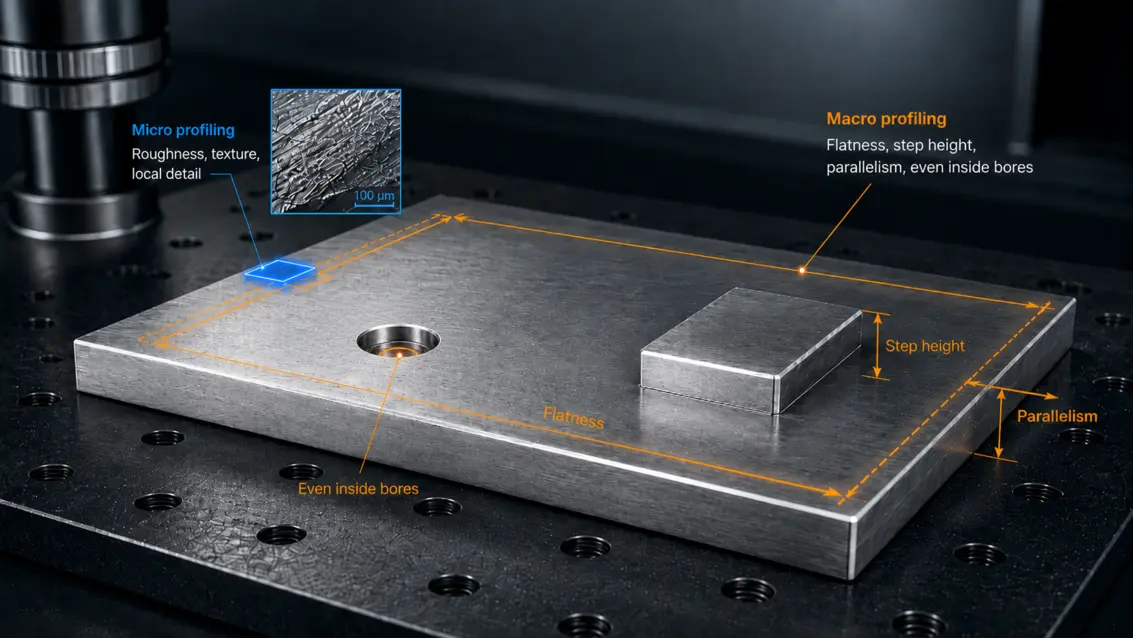
Micro vs. macro at a glance
| Criterion | Micro profiler | Macro profiler |
|---|---|---|
| Main strength | Fine surface detail | Large-area geometry |
| Typical measurements | Roughness, texture, microstructures, scratches, small steps | Form, flatness, parallelism, waviness, warpage, sealing surfaces |
| Field of view | Small to medium, magnification-selectable | Large single-shot, extended by True Stitching |
| Vertical range | Sub-nm Z resolution for the finest detail | Large Z range for big steps and recessed features |
| Typical environment | Lab, development, precision QA, flexible analysis | Production QA, shop-floor inspection, automation |
| Typical samples | MEMS, optics, wafers, coatings, microelectronics | Mechanical components, trays, bores, sealing surfaces |
| Borderline cases | Lean micro if local detail is critical — even on a large part (cover the area with stitching or a low-mag objective) | Lean macro if the feature belongs to a larger form, flatness or throughput task |
How Polytec solutions fit
The guide stays product-neutral through the decision; here is how the choice maps onto Polytec systems.
- Micro.View — the microscope-based white-light interferometer for detailed roughness, texture and microstructure analysis, with sub-nanometer resolution and a wide objective range, down to the 0.6× wide-field objective.
- Pro.Surf — the large-area, telecentric profiler for production-relevant form, flatness, parallelism and recessed features, with a large single-shot field of view, 70 mm Z range and True Stitching for big or multi-part samples.
- Pro.Surf+ — the multi-sensor option for the middle ground: large-area form plus nm-resolved roughness via an added chromatic-confocal line sensor, in a single station.
Decide without locking yourself in — PolyRent. The micro/macro choice does not have to be permanent. If you have equipped a line with a Pro.Surf for production form inspection and an R&D or troubleshooting project suddenly calls for high-resolution roughness, you can rent a Micro.View for the duration — and because both run on the same TopMap software, data, recipes and analysis carry straight across with no retraining.
Still unsure? Send us your part, drawing or measurement requirement. Polytec experts can help define whether a micro or macro profiler fits better — and validate it with a feasibility measurement on your actual sample. Measure, rent, decide — on your terms.
FAQ
What is the difference between a micro and a macro profiler?
Both are non-contact, areal 3D optical profilers. A micro profiler uses microscope-based optics for high lateral and sub-nanometer vertical resolution on a small field of view — ideal for fine detail. A macro profiler uses telecentric optics and a much larger field of view for form, flatness and larger functional areas. The difference is measurement scale, not precision.
Can a micro profiler measure large areas?
To a degree. A low-magnification objective — such as Polytec’s 0.6× on the Micro.View — widens the single field of view to 15.53 × 11.71 mm², and stitching extends it further. For genuinely large functional areas measured efficiently, a macro profiler remains the more practical choice.
Can a macro profiler measure roughness?
Yes. A large-area system can capture roughness, and Pro.Surf+ adds a dedicated chromatic-confocal line sensor for nm-resolved roughness in the same station. If roughness is the dominant, high-resolution requirement, however, a micro profiler is the stronger fit.
Which one do I need for measuring bores or recessed features?
A macro profiler. Its telecentric (parallel) beam path combined with a large Z-scan range lets it reach into bores and recessed features while keeping scale accurate — something a high-magnification microscope objective cannot do.
Do micro and macro systems use the same software?
Yes. The TopMap Micro.View and TopMap Pro.Surf families share the same TopMap software, so measurement recipes, data and analysis transfer between systems — which also makes a temporary PolyRent system easy to slot into an existing workflow.
Quick start into surface metrology
We take our claim Measure what matters seriously — and we support you in whatever way fits your situation. Even if your need is only temporary, or a full system isn’t in the budget yet, you have options: rent a system with PolyRent, or let our specialists run the measurements for you with PolyMeasure. And if you’re looking to buy, we’d recommend starting with a feasibility study or a rental — with the rental fee credited against your purchase price afterwards. Talk to our experts and we’ll recommend the best-fitting approach for your metrology tasks.